

The whole guide
Every section on one page — read straight through, or save it to read offline.
Beverley Minster Companion
A companion to the life of Beverley Minster.
Welcome
A short welcome to the Minster as a thirteen-hundred-year-old community of prayer, mission and care — whoever you are, you are welcome.
The Minster has been a holy place for thirteen hundred years. It inspires awe and wonder in everyone who approaches the magnificent twin towers of the west front; even more when they step inside.
It is a place rich in history, and with a lively story to tell. It is more than a heritage site: today’s community continues the tradition of the first monks — of prayer and welcome, mission and service, love and care for all.
Whoever you are, and however you have come to be here, you are very welcome. The clergy, ministry team and lay ministers are always glad to talk — about anything here, or anything else.
Jonathan Baker
Vicar of Beverley Minster
About this Companion
Who this Companion is for, how to read it, its relationship to the Minster website, and how to make it easier to read.
Who is this Companion for?
Three readers in particular. The first is the genuine newcomer — perhaps wholly new to Christian faith, perhaps a returning church-goer, perhaps a friend or family member of someone who worships here. The second is the Christian new to the area, or new to the Minster, looking for the church that might become their home. The third is the long-standing member who has not yet visited every corner of our life. We hope it serves all three.
How should I read it?
However works for you. It is designed to be read in any order, dipped into when curiosity strikes, and returned to. The Common questions section picks up the questions newcomers most often ask, and each section opens with a question and answers it directly.
What is its relationship to the Minster website?
The Minster website is the source of record for what is on this Sunday and this week. The Companion is a supplementary read alongside it, giving the longer story and the breadth of who we are. Where there is a question of fact, the website is the authority. You can jump to it at any time using the Visit the Minster website button at the foot of every page.
Is everything in here up to date?
We try, but information changes. The Minster website is always the source of record for what is on this week. If you spot something here we have got wrong, or that should be added, please let us know.
How do I make it easier to read?
Use the A− / A / A+ text-size control and the dark-mode toggle at the top of any page. The Companion is built to meet accessibility standards and to work with screen-readers — see our accessibility note.
Common questions about the Minster
The questions newcomers most often ask — dress, belief, what’s on, getting involved, where to sit quietly, and what it costs.
Each is answered briefly here, and treated more fully in the section it links to.
Do I have to dress smartly to come?
No. Come in whatever you have on. Some choose to dress more formally for the eleven o’clock, but for the eight o’clock and the 9.15 jumpers and walking boots are fine. (What each of these services is, and what to expect at it, is explained in Worship at the Minster.)
I am not sure I believe in God. Am I welcome at a service?
Yes.Romans 15:7Welcome is not just good manners at the Minster; it is a command of the gospel — we are told to welcome one another as Christ has welcomed us.“Welcome one another, therefore, just as Christ has welcomed you, for the glory of God.”Romans 15:7Read the passage → Many in the Minster community would describe themselves, on any given day, as more doubtful than confident. Come, listen, sit, sing or pray exactly as you choose. (See Exploring Christian Faith.)
How do I know what is on this week?
The Minster website is the source of record — and you can reach it at any time using the Visit the Minster website button at the foot of every page of this Companion. The weekly notice sheet is printed for Sunday and posted online. The screens at the Minster carry news and what’s on. The private Facebook group “Beverley Minster (and daughter churches) Congregation Members” is the friendliest window onto daily life.
How do I get involved?
The simplest first step is a quiet conversation with one of the clergy or with a lay minister, in person after a service or by writing to the Parish Office at minster@beverleyminster.org.uk. We will help you find the corner that fits.
Where can I just sit quietly without taking part in anything?
St Katherine’s Chapel, off the south Quire aisle, is set aside for prayer and quiet. The Quiet Garden by the Parish Centre is also open during Minster hours. You are always welcome to sit anywhere in the building during opening hours without anyone expecting anything of you.
What does the Minster cost to run?
In the region of half a million pounds a year. The largest part is the cost of ministry — clergy stipends, pensions, housing — and the salaried staff team. The rest looks after a building several centuries old. It is not only salaries and stone, though: part of what we raise goes out again, to support charitable partners at home and abroad and the ministry we share across our own community. The Minster receives no support from the Church Commissioners or from central government, beyond a very limited amount of VAT relief; the money has to be found by the local worshipping community. (See Generous giving and our mission partners.)
A breadth of worship and life
The section that explains the rest: one community holding a cathedral-scale breadth of worship and life as the middle way.
This is the section that explains the rest of the Companion.
Beverley Minster is, by some measures, the largest parish church in England that is not a cathedral. We are a parish, with a parish’s ordinary commitments to those who live within our boundary; and we are a building of cathedral scale, with the music, heritage and regional draw of one. We are one Christian community, and the breadth of how we worship and live together is part of what marks us out.
Imagine a Sunday morning in slow motion. At 8.00, around thirty people gather in the Quire for Holy Communion using the Book of Common Prayer of 1662 — quiet, said, around forty minutes, treasured for its older language. At 9.15, a different group gathers at the West End for the contemporary service — a band, modern songs, tables for conversation, a children’s table, less formal. At 11.00, the Minster Choir leads Choral Holy Communion in the Nave, and the building begins to feel its size. At 5.30, a smaller congregation gathers in the Quire for Choral Evensong, sung in much its present form since 1549.
Add Taizé on the fourth Monday evening of the month, midweek Communion on Thursday morning, Choral Evensong on Thursday evening, the daily Office of Morning Prayer at 8.00, the three associated churches at Molescroft, Woodmansey and Tickton, the linked parish at Routh, and the breadth of week-day life — house groups, the Exploring Spirituality Group, Be Still, Press Pause, Food and Fellowship, Breakfast at God’s, Alpha, Minster Tots, the Junior Choir, the Youth Group, the bell ringers, the walking group, the Eco Church group, the prayer ministry team, the Wellbeing Team, the welcomers, the gardeners — and the picture is something more like a quiet ecology than a single congregation.
The Minster is, in this sense, an unusually broad expression of what the Anglican tradition has long called the middle way. We hold within one church a breadth of styles and traditions that other places tend to separate into different buildings. This is by design rather than accident. The other sections describe each corner with the same care.
The breadth also means newcomers can find their way in through many different doors. Six paths into faith takes that idea seriously, mapping six ways into Christian faith with the Minster’s resources matched to each.
New to faith?
There is no single right way in. Two places to begin for anyone wondering whether Christian faith is for them, or returning after a long absence.
Wherever you are starting from, please begin with two things.
Is there a single right way in?
No. Faith is a journey, and people set off from many places. Some come through questions, wanting to know whether the historical claims hold up. Others come through silence, beauty, choral music or stillness in an old building. Others through ritual and the rhythm of the church year. Others through community, finding they belong before they believe. Others through service. Others carrying doubts they had thought ruled the question out, only to find the doubts welcome too.
None of these is a wrong door. Most people, on reflection, find they have walked more than one path at once.
What does the Minster make of all this?
We have heard preached more than once that the building is a sign, not the thing. The grandeur of the place can suggest that Christian faith is mostly an institutional affair, kept by professionals, organised in committees, conducted in centuries of accumulated language. Some of that is true. But the centre of weight is elsewhere. As Saint Paul wrote to a younger and less impressive church: do you not know that you are God’s temple? The building serves the people, not the other way around.
A useful question to keep returning to, lifted from a recent Evensong sermon: do we know what we are, and if so, what are we building with it?
Six paths into faith
Six ways in — questioning, contemplative, sacramental, communal, serving, doubting — each with self-service resources and Minster-led routes.
Each path below comes with both self-service resources (things you can do under your own steam) and Minster-led routes. They are an invitation rather than a checklist.
You do not need to belong to walk these paths.Matthew 7:7These many paths are really one invitation — to seek. Jesus promised that those who look for God will find him.“Ask, and it will be given you; search, and you will find; knock, and the door will be opened for you.”Matthew 7:7Read the passage → None of the resources below requires you to commit to anything. Use what helps; ignore what does not.
1. The questioning, intellectual path
For the reader who wants to know whether Christianity is historically credible and intellectually serious. You may have a scientific or academic background, or simply be allergic to vagueness.
On your own
- The Bible Course (Bible Society) — a free eight-session video introduction.
- Surprised by Scripture, Tom Wright.
- Being Christian, Rowan Williams — short, beautifully written.
- Being Disciples, Rowan Williams — on the essentials of following Jesus. Also at East Riding Libraries
- Mere Christianity, C. S. Lewis — the classic case.
- Logos Bible Software — a theologically grounded research environment, for AI-assisted study.
At the Minster
- Alpha — evening conversations on the central questions of the faith.
- The Exploring Spirituality Group — chosen topics in plain conversation.
- History talks — in the Nave through the year.
2. The contemplative, experiential path
For the reader drawn by silence, beauty and stillness. You may have come to the Minster for a concert, or sat for ten minutes in St Katherine’s Chapel and noticed something settling.
On your own
- Lectio 365 (24-7 Prayer) — a reflective ten-minute prayer morning, evening and night.
- Seeking God: The Way of St Benedict, Esther de Waal — the gentlest way into monastic spirituality.
- How to Pray, Pete Greig — a down-to-earth guide for normal people.
- Celebration of Discipline, Richard Foster — a modern classic on the spiritual practices.
- Apple Classical (search "The Story of Classical") — for the wider musical tradition.
At the Minster
- Choral Evensong — Sundays at 5.30 and Thursdays at 7.30, in term time.
- Taizé — the fourth Monday evening of the month (except in August and December).
- Press Pause — a Saturday morning seasonal quiet time.
- Be Still — a Christian relaxation session for women.
- Midday Prayers — most weekdays at noon (and on the website).
- The Quiet Garden — by the Parish Centre.
3. The sacramental, liturgical path
For the reader drawn by ritual, rhythm and the church year. The shape of a service speaks more directly than its content; the discipline of returning week by week is itself a form of belief.
On your own
- The Church of England Daily Prayer app.
- The Common Worship: Daily Prayer book.
- The Book of Common Prayer — for the older language, one of the most beautiful books in English.
- The Church of England: prayer and worship — services, readings and resources.
At the Minster
- 8.00 BCP Holy Communion — Sundays.
- 11.00 Choral Holy Communion — in modern English.
- Thursday morning Communion, alternating week by week between the BCP and Common Worship.
- Morning Prayer — said in the Quire at 8.00, Monday to Friday; anyone is welcome.
4. The communal, relational path
For the reader for whom belonging precedes believing. The people you have met at the Minster seem like people you would like to know better, and you wonder whether that itself is the beginning.
On your own
- Stephen Cottrell's pastoral books — for example Praying by Heart: The Lord's Prayer for Everyone.
- The Beverley Minster (and daughter churches) Congregation Members Facebook group — a fair window onto daily life; you are welcome to ask to join.
At the Minster
- House groups — small groups meeting weekly or fortnightly in homes; some study-led, some conversational, some explicitly for those exploring. Try several until you find the right level and rhythm.
- The 9.15 service: café-church style, around tables, with a band, modern songs and a children's table.
- Breakfast at God's — after the 8.00 service.
- Food and Fellowship — the monthly meal out.
- The Exploring Spirituality and Walking groups — and simply turning up week by week.
5. The serving, justice-seeking path
For the reader who finds God less in argument and more in service to others. The only theology that interests you is the one that does something.
On your own
- Christian Aid, Tearfund and the Church Mission Society — accessible introductions to a serving spirituality.
- Surprised by Hope, Tom Wright — the gospel as the renewal of all creation.
At the Minster
- The Minster's Mission Partners — Jacob's Well, Hope into Action, the Beverley Schools Christian Trust, Christian Aid, Open Doors and others.
- The Eco Church group — lectures and events through the year.
- Hands-on teams — gardening, welcomers, sides team, bell ringers, prayer ministry. None is a heavy commitment to begin with.
6. The doubting, hesitant path
For the reader carrying past hurt, scepticism or simple uncertainty. You stopped going for very good reasons, or never quite started, and are not sure the question is open in any practical sense. We are very glad you are reading this.
On your own
- Gilead, Marilynne Robinson — Christian doubt taken seriously and beautifully. Also at East Riding Libraries
- Home, Marilynne Robinson — its companion novel, told from the other family's side. Also at East Riding Libraries
- My Bright Abyss, by the poet Christian Wiman — honest about how faith and doubt coexist.
- Rowan Williams's shorter pieces and sermons — an unhurried companion. There is no rush.
At the Minster
- A quiet conversation with one of the clergy or a lay minister — no expectation that you sign up to anything.
- The Wellbeing Team — by email.
- The Quiet Garden.
- Any of the services above — with no pressure to join in.
How do I take a next step?
If something has caught your attention and you would like to take a small next step, the simplest thing is to speak to any of the clergy or lay ministers in person after a service, or by writing to the Parish Office. We are not specialists in particular doors, and we will help you find one that fits. The clergy and lay ministers are pictured on the digital display screens at the Minster.
When you’re away from Beverley, it is also worth being a “church tourist” — dropping into a service in a tradition different from your own and noticing what surprises you. There is more on this, and why it nourishes, in Different flavours of church.
Is there a wider pilgrimage worth knowing about?
Three particular kinds of going-further-afield are worth knowing about.
A retreat. The Diocese of York runs Wydale Hall, on the edge of the North York Moors, for individual quiet days and longer weekends. The Bar Convent in York, the oldest living convent in England, also welcomes individuals for quiet days and short stays. The clergy and lay ministers all go on retreat from time to time and will gladly suggest a place that might suit you.
A residential course. Cursillo (a four-day Christian renewal weekend often hosted at Wydale) and the Diocesan Pilgrimage are both worth knowing about for those seeking a more intensive exploration of faith in community. Many in the Minster community have found Cursillo at Wydale to be quietly transformative.
A Christian festival. Greenbelt — the long-running festival of Christian art, faith and politics, held each August Bank Holiday weekend at Boughton House in Northamptonshire — is the largest gathering of its kind in the UK and is famously generous to those exploring faith from outside the church. Walsingham, Iona and Taizé itself in Burgundy each host pilgrim communities that many find life-changing.
Nourishing your faith day to day
The daily rhythms and free resources the community draws on between Sundays — the Daily Office, prayer, Bible translations, apps and books.
Most of the Christian life happens between Sundays — and this short, practical section is about those days.
What is the Daily Office, and can I join it?
The Daily Office is the name for the structured, prescribed pattern of daily prayer that the Anglican tradition inherited from medieval monasticism. It has four parts: Morning Prayer (sometimes called Mattins), Midday Prayer, Evening Prayer (sometimes called Evensong) and Night Prayer (sometimes called Compline). The words are appointed for each day; the same readings, psalms and prayers are said by Christians around the world on the same day. Most people keep only part of it; even Morning Prayer once a week is a steadying discipline.
At the Minster, Morning Prayer is said most weekdays just after 8 — somewhere between 8.00 and 8.15, depending on who is leading — in the Quire. It follows the Church of England’s Time to Pray and is short and simple: prayers, a psalm, a Bible reading, more prayers and the Lord’s Prayer. The service is primarily livestreamed on YouTube (anyone can join from home), but you are also very welcome to come in person. Please use the accessible entrance.
What is the Diocese of York Rhythm of Life?
A simple pattern for living as a follower of Jesus, built around seven habits drawn from things he asks of his followers. It sits alongside the Daily Office rather than in place of it, and suits anyone who wants to give their faith a little more shape and regularity without yet taking on a daily round of set prayer.
The seven habits are: praying regularly; being shaped by scripture; being part of the worshipping life of your church; loving one another; living generously; sharing faith with others; and adopting regular patterns of rest. Each comes with simple resources at any depth. Find them on the Diocese of York’s Rhythm of Life pages.
How do I pray?
Prayer is, at its simplest, talking to God. There is no right or wrong way to do it. It does not require a particular posture, place, vocabulary or mood. You do not need to get on your hands and knees; you do not need special words. You can pray walking, lying in bed, on the train, washing up, sitting in St Katherine’s Chapel, or standing at the back of the Minster while you wait for someone. What matters is the turning towards God.
Several traditional shapes have helped many in the Minster community. Praise (telling God who he is). Thanksgiving (gratitude for what God has done). Confession (honesty about where you have fallen short). Petition and intercession (bringing your own and others’ needs before God). Silence (resting in God’s presence without words). Contemplation (slow, attentive reading of scripture or the world).
The shorthand ACTS — Adoration, Confession, Thanksgiving, Supplication — covers four of these. The Lord’s Prayer carries them all in a single short paragraph and is, for many, the place to begin and to return to.
Practical shapes that work: lectio divina (slow reading of a short passage of scripture, four times, with a different posture each time); the Examen (a fifteen-minute review of the day, looking for where God was at work); breath prayer (a single short phrase — “Lord Jesus Christ, have mercy on me” — repeated quietly with the breath). Churches in Beverley have shared Try Praying, a gentle one-week introduction to prayer that is freely available online. None of this needs to be done well. Most of it just needs to be done.
What free online resources do you recommend?
- YouVersion (Bible.com) carries many translations and dozens of reading plans. The Bible Course is a useful starting plan.
- Lectio 365, by 24-7 Prayer, gives a reflective ten-minute prayer each morning, evening and night.
- Bible in One Year, by Nicky Gumbel, takes the reader through the Bible in a year of daily readings.
- The Church of England Daily Prayer app lets you follow Morning, Midday, Evening and Night Prayer wherever you are.
- Logos Bible Software is, on the more serious end, a research environment with academic commentaries; its newer AI assistant is theologically grounded.
Which Bible translation should I use?
No single answer. The New Revised Standard Version (NRSV) is widely used in academic and Anglican settings and is what we read in services. The New International Version (NIV) and the New Living Translation (NLT) are easier on the first-time reader. The King James Version (KJV) is the language of much English literature and worth meeting on its own terms. The Message (MSG), by Eugene Peterson, is a paraphrase loved for its experiential register. Our gentle suggestion: NRSV or NIV for ordinary reading, the BCP psalter for prayer, MSG in spells when scripture has begun to sound too familiar.
Common Worship and the Book of Common Prayer — what is the difference?
Two collections of services structure most Anglican worship in this country. The Book of Common Prayer (BCP) is the historic Anglican prayer book, finalised in 1662, in the language of the King James Bible. We use it at the 8.00 Sunday Holy Communion, and on alternating weeks at the Thursday morning midweek Communion. Common Worship (CW) is the modern collection authorised in 2000, in everyday English; we use it at the 9.15, the 11.00 Choral Communion, the Thursday midweek Communion on its other weeks, and most other contexts. Neither is better than the other; both are alive.
Different flavours of church
A brief family tree of the Christian church and the breadth within Anglicanism, with an invitation to be a “church tourist” beyond Beverley.
The wonderful thing about the Minster is that we celebrate the breadth under our roof1 Corinthians 12:12Paul pictured the Church as one body with many different parts, so the range of traditions and styles under one roof is a feature of the body of Christ, not a flaw.“For just as the body is one and has many members, and all the members of the body, though many, are one body, so it is with Christ.”1 Corinthians 12:12Read the passage → — the BCP eight o’clock and the contemporary 9.15, the Choral Communion and the Choral Evensong, the central Anglican core and the daughter and linked churches. But there is more to explore beyond our own walls.
Across the Christian family — a brief family tree
In its early centuries the Christian church was undivided. The first major split, in 1054, separated the Eastern (now Orthodox) churches from the Western (now Roman Catholic) churches. The Reformation in the sixteenth century then produced several Western Protestant traditions — Lutheran, Reformed (later Presbyterian), Anglican — and over the following centuries further movements arose: the Methodists from within the eighteenth-century Church of England, the Baptist family of churches, the Quakers, the Pentecostal and charismatic movements from the early twentieth century, and a great variety of independent and non-denominational churches in our own time.
What is shared across all of these is the central story: belief in one God, Father, Son and Holy Spirit; the historical reality of Christ; the authority of scripture; the practice of baptism; and (with some variation in detail) the celebration of the Eucharist. What differs is questions of authority, ministry, sacraments, and worship style.
The Church of England is one of the thirty-eight provinces of the Anglican Communion. Beverley has two other Church of England parishes of its own — St Mary’s, the great church at the north end of the town, and St Nicholas to the east — and the Minster works alongside both, and especially closely with St Mary’s through the Two Churches One Town partnership. Beverley is also a happily ecumenical town: the Minster works with the Methodist congregation at Toll Gavel and with the other local churches through Beverley Churches Together.
Within Anglicanism itself — a broad church
Anglicanism is sometimes called a “broad church”, and means it. Historically, four overlapping strands have coexisted within the Church of England, with different emphases.
- Evangelical Anglicans place the centre of weight on scripture as the primary authority, on personal conversion and discipleship, and on mission. Worship tends to be word-centred and often informal.
- Catholic Anglicans (sometimes called Anglo-Catholics) place the centre of weight on the continuity of the Church through history, the importance of the sacraments, and the dignity of the liturgy. Worship tends to be more elaborate; ordained ministry is understood as part of the historic apostolic succession.
- Liberal Anglicans place the centre of weight on the use of reason in interpreting scripture and tradition, the value of doubt and questioning as part of faith, and the church’s engagement with contemporary intellectual and social life.
- Central Anglicanism — sometimes called “middle” or “moderate” — sits between these poles, drawing from each, holding the breadth.
Beverley Minster sits broadly central, but holds the breadth as part of its character. The 8.00 Holy Communion (BCP) carries something of the older catholic tradition, in cadence and form. The 11.00 Choral Communion is recognisably central. The 9.15 has more of the evangelical tradition’s register, and with it an openness to the work of the Holy Spirit that the charismatic renewal has brought to the wider Church. Choral Evensong sits within the great central English choral tradition. Taizé draws from the contemplative-ecumenical tradition.
A final invitation. Whenever you are away from Beverley — on holiday, visiting family, away for work — consider being a “church tourist” and dropping in to a service in a tradition different from your own. An Anglo-Catholic Eucharist with incense, an evangelical-charismatic worship service, a Quaker meeting, a Roman Catholic Mass, a Cathedral Evensong, an Orthodox liturgy. Notice what surprises you. Many of us have found that the breadth of the wider Church is one of the most quietly nourishing things about belonging to it. The clergy are very glad of a conversation about any of this.
Worship at the Minster
The four Sunday services and the rhythm of the week, with what to expect at each — and baptisms, weddings and funerals.
More questions are asked about our worship than about anything else in the Minster’s life. This section takes them in turn.
Why does the Minster have so many services on a Sunday?
Four services across a Sunday — three in the morning, one at half past five — is a lot, and it is a fair question. We believe each meets a different congregation in a different way, and would rather offer all four than ask everyone to fit into one. Each has its own people, its own pace, its own theology in the air. We run all four because the breadth is the point.
| Time | Service | Where | Style |
|---|---|---|---|
| 8.00 | Holy Communion (BCP) | In the Quire | Quiet, said, in the language of 1662 |
| 9.15 | Contemporary service (CW) | At the West End | Café-church style: tables, band, modern songs |
| 11.00 | Choral Holy Communion (CW) | In the Nave | Sung settings led by the Minster Choir |
| 5.30 | Choral Evensong (BCP) | In the Quire | Sung evening prayer in the Anglican tradition |
Service times in our daughter and linked churches vary; please see the weekly notice sheet for the current week.
What is each of the four Sunday services like?
Here is each in turn, in the order it falls across the day.
8.00 — Holy Communion (BCP)
You will find this the quietest service of the Minster’s week. Around thirty people gather in the Quire stalls for Holy CommunionLuke 22:19At the Last Supper Jesus broke bread and told his friends to keep doing it in memory of him. Every service of Holy Communion is the Minster keeping that command.“This is my body, which is given for you. Do this in remembrance of me.”Luke 22:19Read the passage → using the Book of Common Prayer of 1662. The service is said rather than sung, lasts around forty minutes, and is followed by Breakfast at God’s in the Parish Hall — butties, toast, coffee and juice — until 9.30. What makes the service distinctive is its restraint. The cadence of Cranmer’s English is unhurried and dignified; the form has hardly changed in three and a half centuries; many who come treasure both. If you have never heard the Prayer of Humble Access read aloud — “We do not presume to come to this thy table, O merciful Lord, trusting in our own righteousness, but in thy manifold and great mercies” — it is worth coming once to hear it.
9.15 — Contemporary service (CW)
A contemporary service held at the West End under the great west window, in the café-church style — people sit at tables, with tea, coffee and conversation built into the rhythm rather than tacked on at the end. The musical idiom is more recent: a band leads modern worship songs, words appear on a screen, the teaching is in an accessible style. There is a children’s table during the service. The service runs for about an hour. Rather than following a set liturgy word for word, it is shaped afresh each week within a broad Common Worship framework, and includes Holy Communion on the second Sunday of the month. Prayer ministry is available during and after the service.
Both the 9.15 and the 11.00 are family-friendly; the 9.15 is the more informal of the two and hospitable to those who find a fully liturgical service unfamiliar. If you have come having last been at church as a child and found that hard, the 9.15 is often the easiest first step.
11.00 — Choral Holy Communion (CW)
The 11.00 is a Common Worship Holy Communion in the Nave, with the Minster Choir leading the sung settings of the liturgy in the generous acoustic of the building. The service runs for about an hour and a quarter. Children leave during the first hymn for age-group activities at the East End and rejoin in time for the PeaceMatthew 5:23–24Jesus taught that before we bring our gift to the altar we should first be reconciled — so we make peace with one another before we come to the Table.“So when you are offering your gift at the altar, if you remember that your brother or sister has something against you, leave your gift there before the altar and go; first be reconciled to your brother or sister, and then come and offer your gift.”Matthew 5:23–24Read the passage → and Holy Communion. Prayer ministry is offered during Communion and after the service.
What you may notice is the scale and the musical inheritance. The Minster Choir is one of the largest parish church choirs in the country, with separate top lines of Boys’, Girls’, Consort and adult sopranos and a back row of altos, tenors and basses. The choral inheritance reaches back, in this place, eight hundred years.
5.30 — Choral Evensong (BCP)
Choral Evensong is one of the great inheritances of the Anglican Church and one of its quietest gifts. It is a sung evening prayer with a structure that has been largely unchanged since the first English-language Book of Common Prayer of 1549. The choir leads; the congregation listens, joins in the responses and the hymn, and finds itself, after about an hour, considerably more settled than it began.
Its purpose, in a sentence, is to give the day to God. After an opening introit and a hymn, the minister and choir sing the opening responses. The choir sings the appointed psalm. The first reading is from the Old Testament. The choir sings the Magnificat — Mary’s song of praise, given in Luke’s Gospel. The second reading is from the New Testament. The choir sings the Nunc Dimittis — Simeon’s prayer at recognising the infant Christ in the Temple. There is the Apostles’ Creed, more sung prayers, and an anthem. On Sundays a short sermon follows; then prayers, the closing hymn, and the dismissal.
What about our daughter and linked churches?
Three nearby village churches are formally “associated churches” of the Minster parish: St Leonard’s, Molescroft; St Peter’s, Woodmansey; and St Paul’s, Tickton. Each is a worshipping community in its own right, with its own congregation, character and life. Each has its own churchwardens, who — for the three associated churches — are ex-officio members of the Minster’s PCC; the Minster’s clergy and lay ministers officiate at their services, and service times for all of them are kept on the Minster website. The fourth, All Saints’, Routh, is a separate parish in its own right, but has been linked to the Minster since the 1960s and shares our Vicar. Together with the Minster, the five churches form the Beverley Minster benefice. There is more about each of them — their character, history and life — in The wider parish: our associated churches.
Do I have to come up for Communion?
No. At every service, you are equally welcome to come forward for Communion if you are normally a communicant in any Christian church, or to come forward for a blessing — simply cross your arms across your chest as you reach the priest. You are equally welcome to stay in your seat, in which case nothing at all is asked of you.
When am I supposed to stand, sit and kneel?
There is no test. Moving with the service — standing, sitting, kneeling — is one of the ways we worship with our bodies as well as our minds, and it is entirely optional. The general pattern: stand to praise (hymns, the Creed, the Gospel); sit to listen (readings, the sermon); kneel or sit to pray. The order of service tells you when. If you are not sure, look at the row in front and follow. If any of it is uncomfortable, please stay seated.
What about the rest of the week?
Midweek the Minster offers Holy Communion on Thursday mornings at 10.00 (alternating week by week between the BCP and Common Worship), Choral Evensong on Thursday evenings at 7.30, and Taizé on the fourth Monday evening of the month at 7.00 (except in August and December). Taizé is a French ecumenical contemplative tradition in which short, simple chants are sung repeatedly while the congregation rests in silence and candlelight — the closest accessible cousin to monastic prayer. Morning Prayer is said in the Quire at 8.00 each weekday. Midday Prayers are said at noon on most weekdays.
Thursday Evensong, at 7.30, is the same service in a quieter key and with no sermon: music, scripture and prayer at the close of the working day, and for many people the easiest way into Evensong.
Can I follow services from home?
Yes. The principal services are livestreamed on the Minster’s YouTube channel and Facebook page. If you are housebound, recovering, away or simply not yet ready to come in person, you are very welcome to follow from home. Recordings remain available afterwards on YouTube; the Minster website’s live-streamed services page has the links.
I was baptised but never confirmed. Does that matter?
Not in any urgent sense, but worth knowing what confirmation is. Confirmation is the moment a Christian who has been baptised — usually as an infant, increasingly often as an adult — re-affirms for themselves the promises made at baptism. The Bishop prays for the person with the laying-on of hands for the gift of the Holy Spirit. In Anglican tradition, confirmation is the gateway to receiving Holy Communion. The Minster runs preparation classes (often using the Pilgrim or similar course) ahead of confirmation services, which take place once or twice a year. If you would like to be confirmed, please speak to one of the clergy; nothing about it is rushed. The Church of England’s page on confirmation explains the step in more depth.
Can I read or lead the prayers at the 11 o’clock?
We always welcome new readers and intercessors. Reading at a service means reading aloud one of the appointed scripture passages from the lectern; leading the intercessions means writing and leading the prayers for the church, the world and those in need that come after the sermon. Both rotas are friendly; we will pair you with someone who has done it before for the first few times. To go on the rota, please email the Parish Office at minster@beverleyminster.org.uk.
What about baptisms, weddings and funerals?
To make arrangements for any of these, the Minster website’s baptisms, weddings and funerals page is the place to start. If you would like to ask something first, email the Parish Office at minster@beverleyminster.org.uk. Baptism (sometimes called a Christening) marks the beginning of a person’s life as a member of the Church. We hold baptism services for babies and young children at 2.00 on the third Sunday of the month at the Minster, with up to three families involved. Adult baptism is also possible and warmly welcomed. The Church of England’s christenings guide is a gentle introduction to what it all means.
Weddings at the Minster are subject to the usual eligibility rules — broadly, a connection to the parish — but the rules are less restrictive than they used to be, and we will be happy to talk you through your options. Your Church Wedding explains how the connection works and what to expect.
Funeral arrangements are made first with the funeral director, and our clergy take many funerals each week, in the Minster, in our daughter and linked churches, and in cemeteries and crematoria. A service for the bereaved is held at the Minster each year, around Christmas. The Church of England’s funerals pages offer help and reassurance for the bereaved.
To give a sense of scale: in a typical recent year the clergy conduct around twenty baptisms, a dozen weddings and thirty or more funerals across the parish.
The Christian year
The seasons of the church year, their colours and meaning, and the particular Minster moments worth coming to at least once.
The Christian year is a quietly powerful piece of teaching by repetition. It tells the story of Christ across twelve months, and a worshipping community that goes through it slowly finds the year teaching them.
What are the seasons, and what colours do they use?
The table below sets out the year in order, each seasonEcclesiastes 3:1The church year turns with the seasons because Scripture itself teaches that life has God-given seasons and rhythms, each with its own purpose.“For everything there is a season, and a time for every matter under heaven.”Ecclesiastes 3:1Read the passage → tinted with its own liturgical colour — the colour of the hangings and vestments you will see in the building during that season. The seasons vary greatly in length: Holy Week lasts only days, while ordinary time after Trinity is the long stretch that runs from June through to Advent.
| Season | When | Colour | What it remembers |
|---|---|---|---|
| Advent | 4 Sundays before Christmas | Purple | Expectation: the coming of Christ. |
| Christmas | 25 Dec to 5 Jan | White or gold | The Incarnation. |
| Epiphany | 6 Jan to Candlemas (2 Feb) | White | The revelation of Christ to the wider world; the visit of the Magi. |
| Ordinary time | Candlemas to Lent | Green | A short stretch of “ordinary” (counted) weeks. |
| Lent | 40 days from Ash Wednesday | Purple | Self-examination and preparation for Easter; traditionally a season of fasting. |
| Holy Week | Palm Sunday to Easter Eve | Purple / red | Maundy Thursday, Good Friday, Holy Saturday. |
| Easter | 50 days from Easter Day | White or gold | Resurrection: the central celebration of the Christian year. |
| Pentecost | 50 days after Easter | Red | The gift of the Holy Spirit; the birthday of the Church. |
| Ordinary time (after Trinity) | Trinity to Advent | Green | The longest part of the year, running from June through to Advent. Saints’ days, Harvest, All Saints and Remembrance fall here. |
Why is it called “ordinary time”?
From the Latin ordinalis, meaning “counted” — the weeks are simply numbered (the “Sixth Sunday after Trinity”, and so on). It does not mean “boring” or “second-rate”. For many Christians, the long ordinary time after Trinity is when the regular work of growing in faith, in community, takes place.
Which particular Minster moments are worth coming to?
A few worth coming to at least once. The Advent Procession in late November or early December — a candlelit, choir-led service marking the start of the new church year, moving through the building station by station — is one of the most atmospheric services of the year. The Christmas Tree Festival fills the Minster with trees sponsored by well over a hundred local organisations — a shop window for community life across Beverley, and a delight for children. The Carol Services in mid-December (often two of them) are a Beverley institution. The Christingle service is for children. And Easter, above all, is worth coming to: see below.
Holy Week: the heart of the year
Many people are surprised to learn that, for Christians, the week before Easter matters even more than Christmas. Holy Week walks day by day through the last days of Jesus’s life, and the Minster keeps it with some of the most moving services of the year.
On Palm Sunday, which remembers Jesus’s entry into Jerusalem, the choir sings Stainer’s The Crucifixion in the evening in place of Evensong. On the Monday, Tuesday and Wednesday evenings there are short reflections led by the clergy, followed by Compline, the ancient night prayer of the Church, sung by the choir. On Maundy Thursday evening the Communion remembers the Last Supper, the meal Jesus shared with his friends on the night before he died, and feet are washed, as he washed his disciples’ feet. (“Maundy” comes from mandatum, the “new commandment” to love one another.)
Good Friday is the most sombre day of the year. In the morning the choir sings Mattins, almost the only time the Minster keeps that service in the year: stark, unhurried, and for many people the most powerful hour of the whole week. Straight afterwards the churches of Beverley walk together through the town in the Walk of Witness.
Then Easter Day breaks. Early in the morning the choir climbs the West Tower and sings Easter hymns from the top, while the congregation gathers below at the West End; the day goes on with the festal Easter Eucharist and a festal Evensong in the afternoon. The times are published on the Minster website each spring.
Where the Minster’s year meets the town’s
Several moments in the year draw the Minster together with the civic and wider community life of Beverley. The Civic Service for Saint John of Beverley in May brings the Minster and the town’s civic life together. Quebec Sunday, kept on the Sunday nearest 13 September, honours the Minster’s long links with the local regiment. Remembrance Sunday in November is observed with the town’s civic procession. The Walk of Witness on Good Friday morning is a quiet, slow procession with the wider Beverley churches (see Holy Week, above). And the annual Harpham Well Service, on the Sunday closest to Saint John’s feast day, is a longstanding pilgrimage to the spring at Harpham — Saint John’s reputed birthplace — where the choir sings, prayers are said, and water is drawn from the well. The Minster’s outward life reaches beyond the town, too — close to home and around the world — through its mission partners: part of how the community seeks to live the gospel, and not only to speak it.
Where do the words come from?
How a single service comes together, and where all the wording — the readings, the psalm, the prayers, the canticles — actually comes from. A gentle tour of long-established Anglican worship.
Sit through a service at the Minster and a natural question surfaces: who decided all this? Who chose the readings, wrote the prayers, picked out the psalm? The surprising — and rather lovely — answer is that almost none of it was written this week, and very little of it was chosen by Beverley at all. Most of what you hear is the inherited, shared prayer of the whole Church, handed on and polished over centuries. The simplest way to see how it fits together is to follow one service from the beginning. Let us take a Sunday’s Choral Evensong, and watch it come into being.
It begins with the day itself
Everything starts with the date. The Church keeps a calendar of seasons — Advent, Christmas, Epiphany, Lent, Easter, and the long green stretch of Ordinary Time through the summer, counted simply as Sundays after Trinity. The season sets the mood, the colour of the hangings, and — most importantly — which passages of the Bible are read. You can read more in The Christian year. Choose the day, and a great deal follows on its own.
A little deeper
Sundays run on a three-year cycle — Years A, B and C — so the readings rotate and, over time, you hear across the whole sweep of the Bible. The date fixes both the season and which year of the cycle you are in.
The readings are appointed, not chosen
For most of its services, the Minster does not sit down each week and pick Bible readings to suit a theme. They are appointed in advance, by a shared table of readings called the lectionary, used right across the Church of England and much of the wider Church. Evensong has two lessons — one from the Old Testament, one from the New — together with an appointed psalm. It is one of the quiet glories of Anglican worship: a church in Beverley and a church on the other side of the world may be reading the very same words on the very same day.1 Timothy 4:13Reading the Bible aloud together is not a modern habit; the New Testament church was told to devote itself to the public reading of Scripture, and Anglican worship keeps that at its centre.“Until I arrive, give attention to the public reading of scripture, to exhorting, to teaching.”1 Timothy 4:13Read the passage →
A little deeper
The tables are the Church of England's Common Worship lectionaries, published by the Archbishops' Council. The 9.15 contemporary service is the freer exception: rather than following the set liturgy word for word, it is shaped afresh each week within a broad Common Worship framework, and will sometimes gather around a theme.
Reading ahead: which readings, for which service
Many people like to read the lessons before a service, and it is a good habit. The one thing that makes it confusing is that each service draws on a different part of the lectionary, so the readings at 11.00 are not the readings at Evensong. The 11.00 readings are printed on the weekly notice sheet; for the other services, this is how to work them out.
| Service | Which readings | Where to find them |
|---|---|---|
| Sunday 8.00 Holy Communion (BCP) | The readings appointed for the Sunday, in a said service from the Book of Common Prayer | Ask one of the clergy |
| Sunday 9.15 | Usually the morning's Principal Service readings; sometimes gathered round a theme instead | — |
| Sunday 11.00 Choral Communion | The Principal Service: an Old Testament reading (Acts in Eastertide), a psalm, a New Testament letter and the Gospel | The weekly notice sheet |
| Sunday 5.30 Choral Evensong | The Second Service: two lessons and a psalm, different from the morning's | The Common Worship lectionary, "Second Service" column |
| Thursday 10.00 Holy Communion | Alternates week by week between the Book of Common Prayer and Common Worship. The celebrant chooses the readings, which may follow the preceding Sunday's rather than the weekday's | — |
| Thursday 7.30 Choral Evensong | The Additional Weekday Lectionary: one Old Testament and one New Testament lesson. The psalm is chosen by the Director of Music | The lectionary for the lessons; the monthly music list for the psalm |
| Morning Prayer, weekdays | The daily readings and psalms for Morning Prayer | The Church of England's Daily Prayer app |
A little deeper: four things that catch people out
Sunday morning and evening differ. Evensong has its own column in the lectionary, chosen to sit alongside the morning's, so what you hear at 5.30 is not a repeat of 11.00. Now and then an Evensong preacher takes the morning readings instead.
The Evensong psalm can move. On Sundays the lectionary appoints a psalm, but if the Director of Music has chosen another, the music list is what the choir sings. On Thursdays the lectionary appoints lessons but no psalm, so it always comes from the music list.
Feasts and the clergy's choices come first. On festivals, saints' days and special occasions such as Harvest, Remembrance or Saint John's Day, the clergy may appoint particular readings, and those take precedence. A look a week ahead is right most weeks, but check on the day.
The three-year cycle. Sunday readings rotate through Years A, B and C, and the year turns on Advent Sunday. From Advent Sunday 2026 the Church is in Year B.
Whose translation of the Bible?
When the scripture is read aloud at the Minster, it comes from the New Revised Standard Version (NRSV) — the translation used across much of the Church of England, valued for being both scholarly and clear. It is what you will hear from the lectern. Some in the congregation prefer others for their own reading — Eugene Peterson’s vivid paraphrase The Message, or the King James Version for its older music; there is more on choosing a translation in Nourishing your faith.
A little deeper
The NRSV is under copyright, and read at the lectern under the Minster's licence. The psalms are the exception: they are sung from the older Coverdale Psalter (see below).
The psalm — the oldest words you will hear
The appointed psalm is not read but sung, to Anglican chant, from the Coverdale Psalter — Miles Coverdale’s sixteenth-century translation, carried down to us in the Book of Common Prayer of 1662. These are among the oldest words spoken anywhere in the building on a given day, worn smooth by four hundred years of singing.
The Collect — the prayer of the day
Each Sunday has its own short, ancient prayer, called the collect — so named because it gathers, or “collects”, the day’s theme into a sentence or two. At Evensong it is followed by two unchanging evening prayers: one for peace, and one — rather beautifully — for aid against all the perils of the coming night.
A little deeper
At the morning's Choral Communion the collect comes instead from Common Worship, the Church's modern liturgy, rather than from the older prayer book.
The canticles — the Church’s own songs
Between and after the lessons come two great songs: the Magnificat, Mary’s song of joy from Luke’s Gospel, and the Nunc Dimittis, old Simeon’s song of farewell. The words are fixed and ancient; the music is not. The choir sings a named composer’s setting of them — one week Stanford, another Howells — which is why Evensong can feel, at the same moment, utterly familiar and entirely new. There is more on all of this in Music in worship.
The frame that holds it together
All of this hangs on a fixed order of service. Choral Evensong follows the Book of Common Prayer of 1662 almost word for word — the Confession, the Preces and Responses (the sung call-and-answer that opens the service), the Creed, the Suffrages, the Blessing. (The morning’s Choral Holy Communion follows the modern Common Worship instead.) So the greater part of what is said is not composed afresh each week. It is the common inheritance of the Church — and much of it is known by heart by the people in the pews.
A little deeper
The shape shifts gently with the season: Lent sets aside the Gloria, Eastertide adds the Easter Anthems, and the last days of Advent bring the great "O" antiphons.
And the music?
Everything that is sung — the responses, the canticle and anthem settings, the hymns, and the organ voluntary that sends you out — is chosen afresh each month by the Director of Music and published as the Minster’s music list. The hymns are drawn from Hymns Old & New, the Minster’s edition, which is why every hymn has both a number on the board and a first line you may already half-know.
And then it is assembled
Finally the strands are gathered into the single order of service you hold in your hands: the inherited liturgy, the appointed readings and psalm, the day’s collect, and the month’s music. When two sources ever seem to disagree, the rule is simple — the clergy’s particular choices for a day come first, then the appointed lectionary, then the standard texts beneath. What looks, in your hands, like one seamless booklet is really a quiet collaboration between this Sunday and a thousand years of them.
With thanks — and the credits
None of this belongs to Beverley alone, and we are glad to say so. With gratitude, the words you meet are drawn from:
- Liturgy — the Book of Common Prayer (1662, Crown copyright) and Common Worship (© The Archbishops’ Council, 2000), reproduced under the Minster’s CCLI Church and Streaming licences.
- Scripture — the New Revised Standard Version (NRSV), used under the Minster’s licence; and the psalms from the Coverdale Psalter, public domain.
- Readings — the Common Worship Sunday and Additional Weekday Lectionaries (© The Archbishops’ Council).
- Hymns — Hymns Old & New (Kevin Mayhew Publishers).
In recent years a small website has begun gathering all of this together automatically for any given date — the season, the readings, the psalm, the collect of the day. But it only ever assembles these long-established sources in one place; none of the words are new. They never were.
Music in worship
Why the Minster offers such a broad musical palette, how choral and contemporary traditions sit together, the choir, the Snetzler organ, and how to take part.
Music is for everyone. That is a slightly bolder opening than a guide like this usually gives, but it deserves saying upfront: you do not need to be musical to belong here, and you do not need to be musical to enjoy what we sing.Psalm 150Sung praise has been part of the worship of God since the psalms; the choir and congregation together keep that ancient tradition of offering praise back to God in music.“Praise him with trumpet sound; praise him with lute and harp … Let everything that breathes praise the Lord!”Psalm 150Read the passage →
Why does the Minster offer such a broad palette of music?
We are unusually lucky to have access to a broad palette of musical idioms. That breadth serves two things at once. It serves different preferences — some are at home in the choral tradition, some prefer the contemporary worship music of the 9.15, some are quietest in front of a Taizé chant. It also serves different moods. There are days when what you need is the stillness of Taizé or Compline; days when you need the modern, lyrical register of contemporary worship music — the Coldplay or Adele equivalent in a Common Worship Communion — to put you back in your body; and days when you need the full glorious octane of the Snetzler organ and the Minster Choir at full Sunday strength. The Minster offers all three across the course of a week, and there is no shame in moving between them.
How do choral and contemporary music sit together?
A small explainer for those of us who came to all of this without much musical grounding. The Anglican Church has carried two great musical streams alongside one another for several centuries. The choral tradition descends from the medieval monastic liturgy and is built around setting the words of services and psalms to music — the Magnificat at Evensong, the Sanctus at the Eucharist, the chant for the appointed psalm. It is overwhelmingly designed to be sung by a trained choir on behalf of the whole congregation. The contemporary worship tradition descends from the eighteenth-century evangelical revival and the twentieth-century charismatic movements, and is built around songs that the whole congregation sings together, often led by a band, with the emphasis on direct address to God. Both are theology in music; neither is to be looked down on; both are at home at Beverley Minster.
In practice, that means our 9.15 service has a band, projected words and contemporary songs; our 11.00 has the choir leading sung settings of the liturgy with hymns from across the centuries; and our Evensong is almost entirely choral, with a single hymn for the congregation. None is the “real” music of the Minster. They all are.
What is sung in a service?
Most Anglican services involve some sung text. An introit is a short opening sung piece that sets the atmosphere for worship — usually at the start of Evensong or a Choral Communion, before the spoken liturgy begins. A psalm chant is a short tune to which the verses of a psalm are sung in alternating verses. An anthem is a free-standing piece, usually after the prayers, gathering the themes of the service into music. A setting is the music for the parts of the liturgy the choir takes on behalf of the congregation: the Magnificat and Nunc Dimittis at Evensong, or the Sanctus and Agnus Dei at the Eucharist. The voluntary, often played at the end of a service, is a piece by an organist that allows worship to spill out into ordinary life.
Which hymnal do you use, and how do I follow the music?
At the Minster the hymnal in use at most services is Hymns Old and New. The pews carry the words-only edition; you may wish to obtain a copy of the music edition for your own use if you would find it helpful to follow along.
A second tip from experience: look the hymns and worship songs up on Spotify or YouTube during the week. Most have several recordings; ten minutes of listening will turn an unfamiliar tune into a half-recognised one by Sunday. This works best for the 11.00 and Choral Evensong, whose music is known in advance. The songs at the 9.15 and the chants at Taizé are not set out ahead of time, but the same habit works the other way round: a song you half-caught on Sunday is easy to look up and get to know before you next hear it.
How can I go deeper, on my own?
A few resources that have helped people in the Minster community get under the skin of choral and church music. The Diocese of York’s own choral awards scheme — which Robert leads our choristers through — is the structured route many of our young singers follow; the RSCM (Royal School of Church Music) Voice for Life programme is the national alternative, and well worth knowing. The RSCM Chorister Companion is a good handbook on church music for the curious adult. GCSE and A-level Music revision guides are surprisingly well-written compact introductions to musical form, harmony and history; they will give you the vocabulary that lets you follow what you hear. Apple Classical is a streaming service designed for classical music; search for “The Story of Classical” within the app for a sweeping introduction to where sacred music sits within the wider classical and popular tradition. The BBC Radio 3 podcast Composer of the Week is a slow, civilised education by stealth.
Tell me about the Minster Choir
One of the largest parish church choirs in the country — counting the Junior Choir, more than a hundred people sing here. It sings two services on a Sunday and an Evensong on a Thursday, and contributes to special services, recordings, concerts and tours. It comprises separate top lines of Boys’ voices (8+), Girls’ voices (8+), the Consort (girls aged 14 and over) and adult sopranos, supported by a “back row” of altos, tenors and basses. The Junior Choir, for children aged 5 to 8, can be a useful entry point. Membership is free, and Choral Foundation Scholarships, available for choristers aged 8 to 14, provide bursaries of up to 100% towards individual music lessons. Children have been singing in the Minster for more than 800 years.
What about the organ?
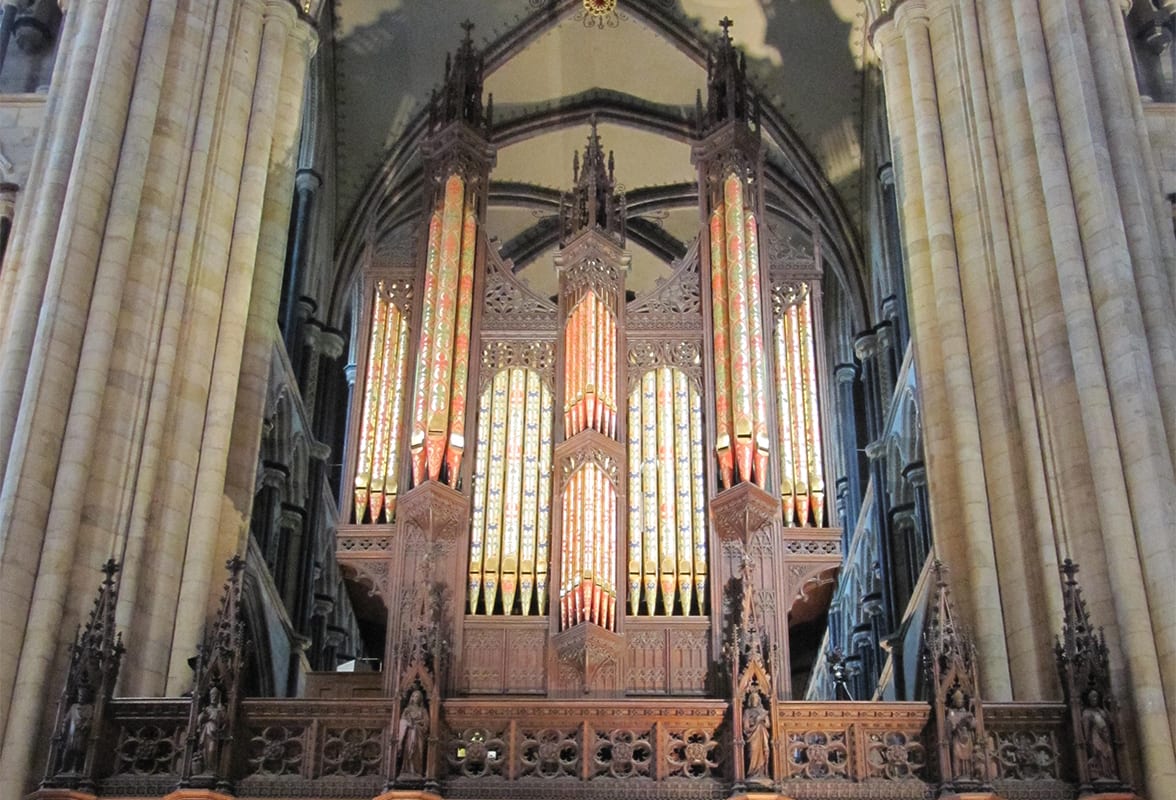
The current organ, by John Snetzler, was installed in 1769 and opened with a great festival of the music of Handel. The instrument has been refurbished several times — most recently in 2015 — but the present organ still contains some of Snetzler’s original equipment and pipes. Over four thousand pipes, four manuals and a pedal board, seventy-five stops. The screen, designed by Sir Gilbert Scott in 1885 and carved locally by James Elwell, is one of the visual focal points of the building.
There is more about the instrument on the Minster’s organ page; its full technical specification is catalogued on the National Pipe Organ Register. For a closer look, there is a video tour of the organ — a climb up among the pipes and mechanism.
How can I be part of the Minster’s musical life?
You do not need to be in the choir, but children who like singing are warmly invited to a voice trial; the contact form is on the Minster website’s choir page, or speak to Robert Poyser, Director of Music, at music@beverleyminster.org.uk. Adults who can read music are also welcome to ask Robert about joining the back row of the Choir, or about joining the worship band that leads the music at the 9.15 service — a separate thing, equally important, and always glad of more musicians. Anyone who simply wants to listen is welcome at Evensong, the Friday lunchtime concerts, the regular organ recitals, and a range of concerts through the year. Robert is unfailingly generous to those who want to deepen their understanding; do not be shy in asking him what to listen for, what to read, what to follow up on.
Community life beyond Sunday
A directory of the Minster’s mid-week life — reflective, learning, eating-together, and active groups — for someone wanting more than Sunday.
The Minster’s mid-week life is broad enough that there is something on most days, somewhere in the building, for someone in our community. The directory below lists the regulars; the weekly notice sheet and the Beverley Minster (and daughter churches) Congregation Members Facebook group are the best places for what is on this week.
Quietly reflective
- Be Still — a Christian relaxation session for women, in the Peter Harrison Room on selected evenings; gentle breathing, guided prayer, relaxation, quiet music. Bring a blanket.
- Press Pause — a Saturday morning seasonal event for time out with God, with teaching, prayer and discussion.
- Exploring Spirituality Group — a monthly meeting, usually on a weekend morning, working through a chosen topic in plain conversation; led in turn by clergy, lay members and guests.
- The Quiet Garden — next to the Parish Centre; part of the international Quiet Garden Movement; available for private prayer through Minster opening hours.
- Hour of Prayer — Monday mornings at 11.00 in St Katherine’s Chapel; open to anyone who would like to pray with others for the Minster and the wider world.
Discussion and learning
- Alpha — in seasons in the Parish Hall; a meal, a film and small-group conversation, over several weeks.
- History talks — through the year in the Nave, often in collaboration with local historians.
- Cultural exhibitions — the Minster hosts arts and cultural exhibitions in the building from time to time (recent examples include Gaia and the Threads community arts project).
- Lent Library — an occasional offering: the ministry team and members of the congregation lend their own books to a colour-coded library in the North Transept. It has been warmly received each time it has run; watch the notice sheet to see when it next returns.
Eating and being together
- Breakfast at God’s — in the Parish Hall on Sunday mornings, 8.45 to 9.30: butties, croissants, cereals, coffee and juice. Come after the 8.00 service or before the 9.15.Acts 2:46Eating together has been part of Christian community since the very beginning — the first believers broke bread in their homes with glad and generous hearts.“Day by day … they broke bread at home and ate their food with glad and generous hearts.”Acts 2:46Read the passage →
- Men’s Breakfast — Saturday mornings at 8.00 in the Parish Hall; food and unhurried conversation.
- Food and Fellowship — a monthly meal out; a warm welcome, no expectation that you know anyone.
- Minster Marigolds — friendly social gatherings for the women of the congregation, built around lunches, coffees and craft mornings; the next gathering is announced in the weekly notice sheet.
- Mothers’ Union — the Minster’s branch of the worldwide Anglican movement supporting families and marriage through prayer, fellowship and practical action; it meets on Tuesday afternoons in the Peter Harrison Room (details in the weekly notice sheet or from the Parish Office).
- House groups — small groups across the area meeting in homes weekly or fortnightly. Some are study-led, some conversational, some pastoral; the right group is the one whose level and rhythm matches yours. Ask the Vicar or one of the clergy, who will put you in touch with the right person and help you try several.
Active and practical
- Walking Group — regular walks of varying lengths in the East Riding countryside, with conversation along the way.
- Heritage craft workshops — hands-on Saturday sessions in traditional crafts such as calligraphy, bookbinding and sewing, led by visiting craftspeople, held from time to time through the year and bookable through the Minster website.
- Bell Ringers — ringing the Minster’s ten bells for Sunday services and special occasions, led by our Tower Captain Mike Robson; new ringers welcome — see The bell tower.
- Table tennis — in the Parish Hall on Thursday afternoons.
- Eco Church group — working towards the A Rocha Silver award, with regular lectures and events.
- Gardening team — looking after the Secret Garden and the wildflower areas. Some flowers from the garden end up in the Minster.
- Sides team — welcoming worshippers, distributing orders of service, taking the offering at services.
- Prayer Ministry team — offering prayer with worshippers during and after the Sunday morning services.
- Welcomers — on the door whenever the Minster is open, ready with a hello and a guide to the building.
- Wellbeing team — supporting members and groups within the Minster community, especially those who are struggling.
To find out more about any of these groups, or to join one, ask at the Parish Office (minster@beverleyminster.org.uk), speak to one of the clergy after a service, or look for the contact given in the weekly notice sheet. Whoever you ask will put you in touch with the right person.
If you spot something missing from this directory — and there will be — please let us know so we can add it.
Pastoral care
The quiet, confidential work of supporting people when life is difficult — how to ask, prayer ministry, retreats nearby, and confidentiality.
What is pastoral care at the Minster?
The quiet, confidential work of supporting members of the community when life is difficult. It includes a one-to-one conversation, a visit at home — with practical support — for those who can no longer easily come to the Minster, prayer, the service for the bereaved held at the Minster each year around Christmas, and the everyday accompanying of one another through joys and sorrows.Galatians 6:2Caring for one another in hard times is not extra to the Christian life; Paul calls it the fulfilling of the law of Christ.“Bear one another’s burdens, and in this way you will fulfil the law of Christ.”Galatians 6:2Read the passage →
The Wellbeing Team (formerly the Pastoral Care Team) brings together clergy and lay members, with a vision of supporting all members of, and groups within, the Minster community — especially those who are struggling. The team is also developing safe, sustainable mentoring support for young people where there is a need.
How to ask for pastoral support: speak to any of the clergy in person after a service, email the Wellbeing Team directly at pastoralcareteam@beverleyminster.org.uk, or speak to one of the lay ministers. If you would rather write it down, there are paper request forms on the table by the Highgate entrance, with a safe box to post them in — useful if you would like a call or a visit. Conversations are held in confidence, within the one important limit explained under “Confidentiality” below. (One practical note: email to the Wellbeing Team arrives in a shared mailbox read by the whole team — so if you would rather speak to one person alone, ask for them by name or speak in person.)
Do I have to be a regular worshipper to ask?
No. You do not need to be a regular, and you do not need to explain in advance why you would like to talk. The team includes clergy and lay people, and the work ranges from a quiet conversation to practical visits.
What is prayer ministry?
Prayer ministry is offered during and after the Sunday morning services, in the prayer area near the prayer table. There is no formal preparation; you simply tell the team member what you would like to be prayed for, or for whom, and they will pray with you.James 5:14Praying with and for one another — including for those who are ill — is a practice the first Christians commended, and the Minster keeps it.“Are any among you sick? They should call for the elders of the church and have them pray over them, anointing them with oil in the name of the Lord.”James 5:14Read the passage → It is brief and confidential.
Where else can I go nearby?
The Diocese of York’s pastoral structures are available, and Wydale Hall — the diocesan retreat centre on the edge of the North York Moors — offers individual and group retreats, quiet days, study days and parish weekends. Many in the Minster community go to Wydale at least once a year.
Confidentiality
Conversations with clergy, lay ministers and the Wellbeing Team are held in confidence, and that confidence is taken seriously. It is not, however, absolute. If something is disclosed that raises a concern for the safety or welfare of a child or a vulnerable adult, we are obliged to follow the Church of England’s safeguarding procedures, summarised in our safeguarding note. If you would like to know in advance how confidentiality would be handled in your situation, please do ask — the clergy will be glad to explain before you share anything.
The bell tower
The community two storeys above the Nave — the ten bells, their history, the craft of ringing, and how to join the ringers.
Who is up in the tower, and what are they doing?
High above the West End is a community most of us never see. The bell ringers gather to ring the Minster’s peal of ten bells — hung in the north-west tower — for Sunday services, weddings, civic occasions and the great feasts of the year.Psalm 122:1The bells call the town to worship — an echo of the psalmist’s gladness at being summoned to the house of God.“I was glad when they said to me, ‘Let us go to the house of the Lord!’”Psalm 122:1Read the passage → Their tradition stretches back centuries, has its own beautiful and complicated language (with terms like changes, plain hunt, methods, peals and quarter peals), and their work is some of the most distinctive sound that a passer-by in Beverley hears across a Sunday morning.
What is the history of our bells?
Longer than almost anything else still in daily use here. Records show the Minster possessed two bells in 1050 — before the Norman Conquest. Four bells were installed in 1366, and three of them, since recast, are still rung today. The restoration of the Minster under Thomas Mease brought a great bell to the south-west tower in 1703 and a treble in 1747. Canon Nolloth, the long-serving Victorian-era Vicar, oversaw two major overhauls — in 1896 and 1901, by Taylor of Loughborough — which raised the ringing peal in the north-west tower from eight bells to ten.
Great John, the great bell of the south-west tower, dates from 1901: over seven tons in weight and more than seven feet across. He strikes the hours; the quarters are chimed on all ten ringing bells, to a melody composed by John Camidge, then the Minster’s organist. And a detail to delight in: Great John’s Latin inscription dedicates him not to our own saint but to his namesake — “I am called the great bell of Saint John the Evangelist, 1901.”
The ringing tradition is very much alive. In March 2022 a newly composed peal of five thousand changes — the St John of Beverley Surprise Royal — was rung for the first time, marking thirteen hundred years since Saint John’s death in 721.
Is bell ringing difficult?
Bell ringing is genuinely a craft. The ringers learn to control the bell with timing and weight rather than force; the patterns they ring (called methods or changes) are mathematical sequences that take years to master. Visitors to a tower practice are often surprised by how quietly and steadily the room hums, and how seriously the ringers take their work.
How do I join the ringers?
The Minster bell ringers are always glad to welcome new ringers, and the Tower Captain — Mike Robson — is unfailingly patient with beginners. The ringers practise every Tuesday evening. You do not need to be musical (though it helps to count). There is a steady period of training, and you will be ringing simple changes within a few months. Please ask at the Parish Centre and Lauren will put you in touch with Mike directly.
Bell ringers, like the rest of us, are part of the community below as well as the community above the Nave. Several ring at services and then come down to attend them. Several do not. Both are honoured.
The wider parish: our associated churches
The Minster's family of village churches — St Leonard's Molescroft, St Peter's Woodmansey, St Paul's Tickton, and the linked parish of All Saints' Routh — each with its own building, congregation and character.
Beverley Minster is not one church but the heart of a small family of them. This Companion is as much theirs as the Minster’s.
How are they connected to the Minster?
Three village churches — St Leonard’s, Molescroft; St Peter’s, Woodmansey; and St Paul’s, Tickton — are formally “associated churches” of the Minster parish. A fourth, All Saints’, Routh, is a separate parish in its own right, linked to the Minster since the 1960s and sharing our Vicar. Together the five form the Beverley Minster benefice: they share clergy and lay ministers, and much of the life of prayer — while each keeps its own building, its own congregation, and very much its own character. For this week’s service times at any of them, the Minster website is the live source.
St Leonard’s, Molescroft
A warm and welcoming church on the growing northern edge of the town, St Leonard’s was built in 1896 and seats around seventy; a later extension added a kitchenette and toilet. Hospitality is part of its character — refreshments follow every service. The year turns around a much-loved Harvest Festival, a Book of Common Prayer service sung with the Minster Choir that draws the church’s largest congregation and is rounded off with a harvest supper. There is a Pet Service, a Mothers’ Union Songs of Praise, and the great festivals besides, and two fine stained-glass windows — one, behind the font, thought to be the work of the Victorian studio of C. E. Kempe. The Sunday service is Holy Communion at 9.30.
St Peter’s, Woodmansey
Consecrated in 1898, on the Hull Road opposite the village school, St Peter’s is woven deep into village life and holds a particular place in remembrance. Its churchyard is a Commonwealth War Grave site, and service personnel are commemorated within the building; the year includes an Armistice Day service at the village cenotaph. There are close ties to Woodmansey Church of England Primary School — the clergy lead worship there, and the school keeps its Easter, Harvest and Christmas services in the church — as well as seasonal carol singing, and a steady rhythm of prayer and pastoral care through the year. The worship ranges from a formal Communion to a relaxed all-age service.
St Paul’s, Tickton
St Paul’s is something a little different: a Local Ecumenical Partnership, formed in 1994, in which Anglicans and Methodists worship as one fellowship. Pastoral care is shared between the Minster’s Vicar and a minister of the Beverley Methodist Circuit, and there are two church buildings between them — St Paul’s itself, built in 1846 and seating about a hundred, re-ordered with a kitchen, a toilet and an accessible porch, and the Methodist Church nearby. Its stated aim is simply “to enable the Christian people of Tickton to worship together in one fellowship”. There is lively work with children and young people, deep links with the village Church of England school and its governors, and a real appetite for village life — the Scarecrow Hunt among it.
All Saints’, Routh
A short way north-east of Beverley, All Saints’ is the ancient one — proudly its own parish, but sharing our Vicar and much of our common life since the 1960s, when Routh found itself without a Rector of its own for the first time in six hundred years. A Grade II* listed building, it repays a visit for its history alone: medieval brass effigies believed to be of Johannes Routh and his wife Agnes; a tombstone reaching back to the thirteenth century; and windows that remember a son of the parish’s safe return from the Great War.
Can these pages grow?
Yes — and we hope they will. Each of these churches has more to say about itself than a paragraph can hold, and in time we would like to give each of them fuller space here, in their own words. If you worship at one of them and would like to help tell its story, please let us know.
Children, families and young people
What happens for children at Sunday services, the mid-week groups for every age, joining the choir, and how safeguarding is handled.
We are committed to supporting families, children and young people. We do this by running regular groups throughout the week for babies, toddlers, primary-school-aged children and young people at the three secondary schools in our town. Our prayer is that every child and young person we meet will learn about God, meet JesusMark 10:14Jesus insisted that children belong at the very heart of God’s family, and welcomed them when others tried to keep them away.“Let the little children come to me; do not stop them; for it is to such as these that the kingdom of God belongs.”Mark 10:14Read the passage →, and find that they have an important and valued part to play in the community of the Minster.
What happens for children at our Sunday services?
At the 9.15 and 11.00 services there is a crèche area at the West End with toys and books for the smallest children, and age-specific groups in the middle of the service where children and young people can explore a Bible story in their own way. At the 9.15 there is a children’s table during the service led by our team. At the 11.00, children leave during the first hymn for age-group activities at the East End and rejoin in time for the Peace and Holy Communion. Some children come forward for a blessing; some, depending on their tradition, come forward to receive Communion. For more about any of our provision for children and young people, contact our Youth and Children’s Minister, Ben, at ben@beverleyminster.org.uk.
What is on during the week?
- Minster Tots — Tuesday mornings at 9.30 in the Parish Hall: fun, arts and crafts, singing, story time and snacks (voluntary donation £2 per family). The natural starting point for a parent or carer with a small child.
- Junior Choir — Wednesday afternoons at 4.30 during term time. A free community choir for primary-school-aged children. From age 8, children may join the senior choir lines and apply for Choral Foundation Scholarships. Contact bmjchoir@gmail.com.
- Beacons — a fortnightly Bible study group for young people at that in-between point of upper primary and early secondary school: questions, learning, laughter and food in a safe, nurturing space.
- Youth Group (Oasis) — Tuesdays from 3.30 to 5.30 in the Parish Hall during term time: an after-school drop-in for young people across the three secondary schools in Beverley.
And through the year?
Family Morning happens in the Minster during the school holidays — big events with crafts, stories, prayer and refreshments, for families with primary-school-aged and younger children. Me & My Dad is a monthly Saturday-morning gathering for dads (and grandads, and father-figures) and their children. Dates for both are advertised in the fortnightly families newsletter — sign up via the Minster website — and in the weekly notice sheet.
The Minster also welcomes school visits, from nursery age through to GCSE — guided tours and workshops led by the Minster team, or pre-booked self-guided visits. Teachers can find resources and the booking form on the Minster website.
How does my child join the Minster Choir?
If your child enjoys singing, the Minster Choir would love to meet them. Voice trials are informal — a chance for the child to sing a short piece, learn a couple of things by ear, and get a sense of whether the choir might be for them. Please contact Robert Poyser at music@beverleyminster.org.uk, or use the form on the Minster website.
What about safeguarding?
The Minster takes the safety of children, young people and vulnerable adults very seriously. There is a fuller note on safeguarding. The short version: there is a Parish Safeguarding Officer (Meg Choules), a Diocesan Safeguarding Team, and a clear policy and reporting route. Anyone who works with children at the Minster has been DBS-checked and trained.
Our community of volunteers
Why an everyday-open church of cathedral scale runs on volunteers, what they do across the building’s life, and how to find the corner that fits.
Why is this a section on its own?
Because the Minster is open every day of the year except Boxing Day. Cathedrals — even small ones — manage that with paid staff. We manage it because of an extraordinary number of volunteers, who hold the door open, welcome the visitor, take the service round, sing the choir part, ring the bell, prune the rose, hold the prayer, brew the coffee, count the collection, mend the cushion, plant the seed, listen to the worry, and then come back next week and do it again. This is the place where we say so plainly.
We are a parish church, but a very large one. The cathedral chapter that would, in another building, employ the staff to do all of this simply does not exist here. Our paid team — the clergy, the Director of Operations, the Administration Manager, the Director of Music, the Youth and Children’s Minister, the Shop Manager, the Safeguarding Officer and the Virgers — is a small one for a building of this scale and this much daily life. The rest is volunteers.
What do they actually do?
Across an ordinary month, Minster volunteers will between them welcome thousands of visitors, lead three or four hundred service moments, ring the bells in the tower, sing or play in upwards of a dozen services, prepare and serve breakfast for the 8.00 congregation, run Minster Tots, the Junior Choir, the Youth Group, Alpha, Be Still, Press Pause, Exploring Spirituality, the Walking Group, several house groups, the Eco Church group and the Gardening team, take prayer ministry at the 11.00, help at funerals and weddings and baptisms, look after the Minster Shop, count the collection, manage the rotas, send out the newsletter, run the social media, write the weekly notice sheet, prune the Secret Garden, look after the candles, the linens and the silver, clean and mend, fix and pray.
Welcomers and tour guides?
The Welcomers are the team on the door whenever the Minster is open. They greet, help with directions, answer the question that did not quite know how to ask itself, and — when wanted — walk visitors round the building. Many are quietly extraordinary in their knowledge of the building and its history; on a quiet weekday, you can ask for a guided wander and almost always get one.
Sides team and serving teams?
The Sides Team welcomes worshippers, hands out orders of service, helps with seating and takes the offering. The serving and chalice teams help with the practical work of the Eucharist. The Virgers are the senior lay members of the staff team who care for the building, the services and the visitors; they are paid, but a great deal of what they do depends on the volunteers around them.
Music and bells?
The choirs at the Minster — Boys’, Girls’, the back row, and the Junior Choir — are largely volunteer. Choristers receive bursaries; adult singers come for the love of it. The Director of Music is paid; almost everyone he conducts is not. The bell ringers up in the tower (see The bell tower) ring the Minster’s ten bells for Sunday services and special occasions — a tradition unto themselves.
Pastoral, prayer, garden, eco?
The Wellbeing Team and the Prayer Ministry team are both volunteer-led; their work is some of the quietest and most sustaining in the life of the Minster. The Gardening Team looks after the Secret Garden and the wildflower areas. The Eco Church group works through the A Rocha awards. Flower arrangers and a cleaning team complete the picture.
Children, young people, office, shop?
Minster Tots, Junior Choir, Youth Group, the children’s tables — all are run by teams of volunteers under Ben Merrell’s leadership. The volunteer receptionists keep the Parish Office open Tuesday to Friday from 10.00 to 15.00, alongside Lauren Simpson, the Administration Manager, and the operations team led by Kate Howell. The Minster Shop is staffed by volunteers under Jane Myers; all profits from the shop are donated to the Parochial Church Council.
Want to volunteer? The simplest first step is the volunteer application form on the Minster website’s Volunteering page. If you would rather talk it through first, write to the Parish Office at minster@beverleyminster.org.uk, speak to Lauren Simpson at the Parish Centre, or mention it to one of the clergy after a service.
Tell us a little about what you would enjoy doing and how much time you can give, and we will pair you with the corner that fits.1 Peter 4:10Every volunteer role is a way of using a God-given gift to serve others — which is exactly what the New Testament asks of each Christian.“Like good stewards of the manifold grace of God, serve one another with whatever gift each of you has received.”1 Peter 4:10Read the passage → Nothing is a heavy commitment to begin with.
“Cathedrals have staff. Parish churches have neighbours.” — overheard at coffee. We are quite proud of being a parish church.
The Minster in the community
Why the Minster has mission partners, who they currently are, and how the Minster is woven into the wider life of Beverley.
Why does the Minster have mission partners?
The Minster does not exist for itself. We are a parish in the Church of England, and the parish system carries with it a commitment to the people who live within our boundary — Christian, of another faith, or of none — and beyond that boundary, through partnerships, to the wider work of God’s kingdom in the world.Matthew 25:40Jesus taught that love shown to the poor, the hungry and the stranger is love shown to him — which is why the Minster’s care reaches beyond its own walls.“Truly I tell you, just as you did it to one of the least of these who are members of my family, you did it to me.”Matthew 25:40Read the passage →
Who are our current Mission Partners?
The list is reviewed periodically by the PCC; current partners are a mixture of local, national and international.
- Jacob’s Well — a Beverley-based international aid and disaster relief charity raising millions each year for medicines, educational materials, wheelchairs, food, blankets and more for nearly twenty countries. The shop, café and garden in Ladygate are open to visitors.
- The Beverley Schools Christian Trust (BSCT) — supports services for young people in Beverley.
- Hope into Action — local people have raised money to buy a house for those at risk of homelessness, and to employ a support worker.
- Mustard Seed — we support a children’s and families’ worker at Holy Nativity Church in Eastfield, Scarborough.
- St Joseph’s Hospital — a hospital providing health care in a remote area of the Democratic Republic of the Congo.
- The Christian Service Unit — the demonstration of God’s love in action towards the poor and the needy.
- The Church Mission Society — we support Andy and Kati Walsh, working with local church partners in Brazil.
- One Mission — nurturing and empowering communities for women.
- Open Doors — welcoming and helping destitute asylum seekers, refugees and migrant workers in Hull.
- Christian Aid — working towards a world where everyone can live a full life, free from poverty.
Each month one of these partners is given a focus in the weekly notice sheet, with an invitation to pray with us for their ministry. There is more about each on the Minster’s mission partners page, and the Minster’s welcome to asylum seekers and refugees is part of the wider Sanctuary project.
What about local life?
Beyond the partner list, the Minster is woven into the daily life of Beverley. Beverley Churches Together brings the Christian congregations of the town into shared work and prayer. The Sponsored Pilgrimage for Christian Aid each May begins at Toll Gavel and visits the churches around Beverley. The Civic Service for Saint John of Beverley in May is the moment in the year when the town’s civic and church lives meet most visibly. The Minster Shop offers a welcome to visitors and a quiet income to support our work; venue hire for community use brings concerts, talks and gatherings into the building. The Friday lunchtime concerts — and the regular evening concerts and recitals — are part of the Minster’s cultural contribution to the town and to the East Riding. The Minster is also a year-round collection point for the East Yorkshire Food Bank. And a great many in the congregation serve the town directly, giving their time to local charities — among them the Community Kitchen, Open Doors in Hull, the Cherry Tree Centre, Jacob’s Well and the Beverley Schools Christian Trust.
Our building and its grounds
The building as a place that serves the worshipping community — what to look at inside, the particular treasures, the grounds and the gardens.
The Minster is one of the most beautiful Gothic buildings in Europe. Its dimensions are cathedral-scale: 333 feet (102 metres) in length, with twin west towers visible across the surrounding countryside. The visitor leaflet treats the building as a tourist destination. This section takes a slightly different angle: the building as a place that serves the worshipping community, and the grounds as part of that life.
What am I looking at, inside?
Stand at the West End and look east. The Nave runs ahead of you in the Decorated Gothic style of the early fourteenth century, with windows of curving tracery and label-stops carved with heads, animals and figures. Beyond the Nave, the great organ screen — designed by Sir Gilbert Scott in 1885 and carved locally by James Elwell — separates the Nave from the Quire. The Quire is the early Gothic east end, in the Early English style of the late twelfth and early thirteenth centuries, with pointed arches, lancet windows, dog-tooth moulding and shafts of black Purbeck “marble” from Dorset. Beyond the Quire is the Sanctuary, with the High Altar and the eighth-century Sanctuary Chair — the oldest object in the Minster, dating from St John of Beverley’s original monastery. Beyond the Sanctuary is the Retro-quire, with a 2004 stained-glass window and copper figures by Helen Whittaker celebrating pilgrimage — where pilgrims came in their thousands across the medieval period to pray at the shrine of St John.
What are the particular treasures to look out for?
The Percy Canopy on the north side of the Sanctuary, recognised as one of the masterpieces of English Decorated stone carving — built between 1340 and 1349, a vision of paradise carved in stone. Sixty-eight misericords in the Quire stalls, the largest collection in any English church, carved by the Ripon School in 1520. More than seventy medieval carvings of musicians depicting twenty different instruments, believed to be the largest such collection in the world. The Norman font, dating from around 1170, in Frosterley marble, still used for baptisms. St Katherine’s Chapel, off the south Quire aisle, set aside for prayer.
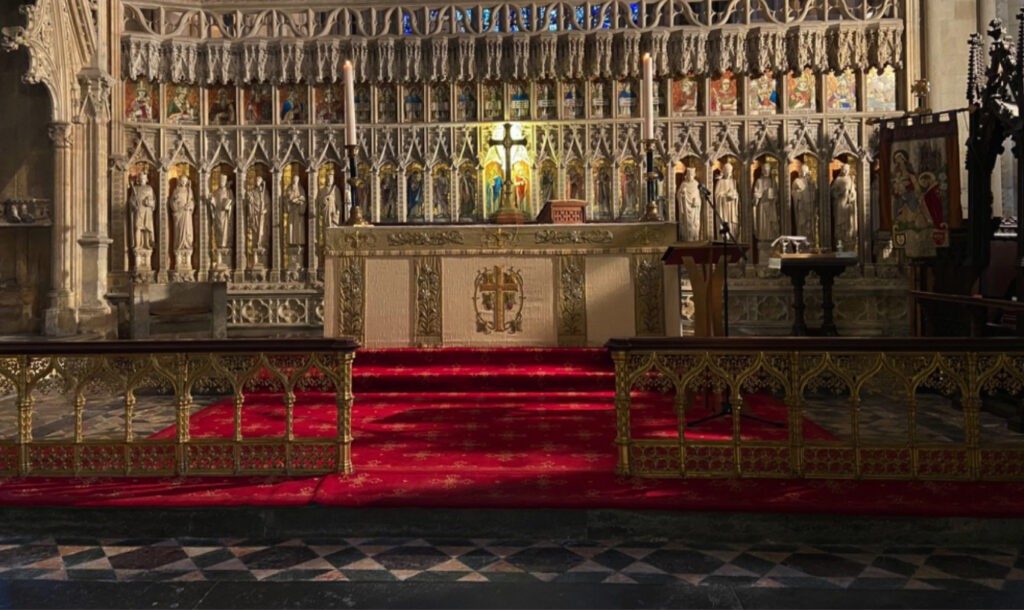
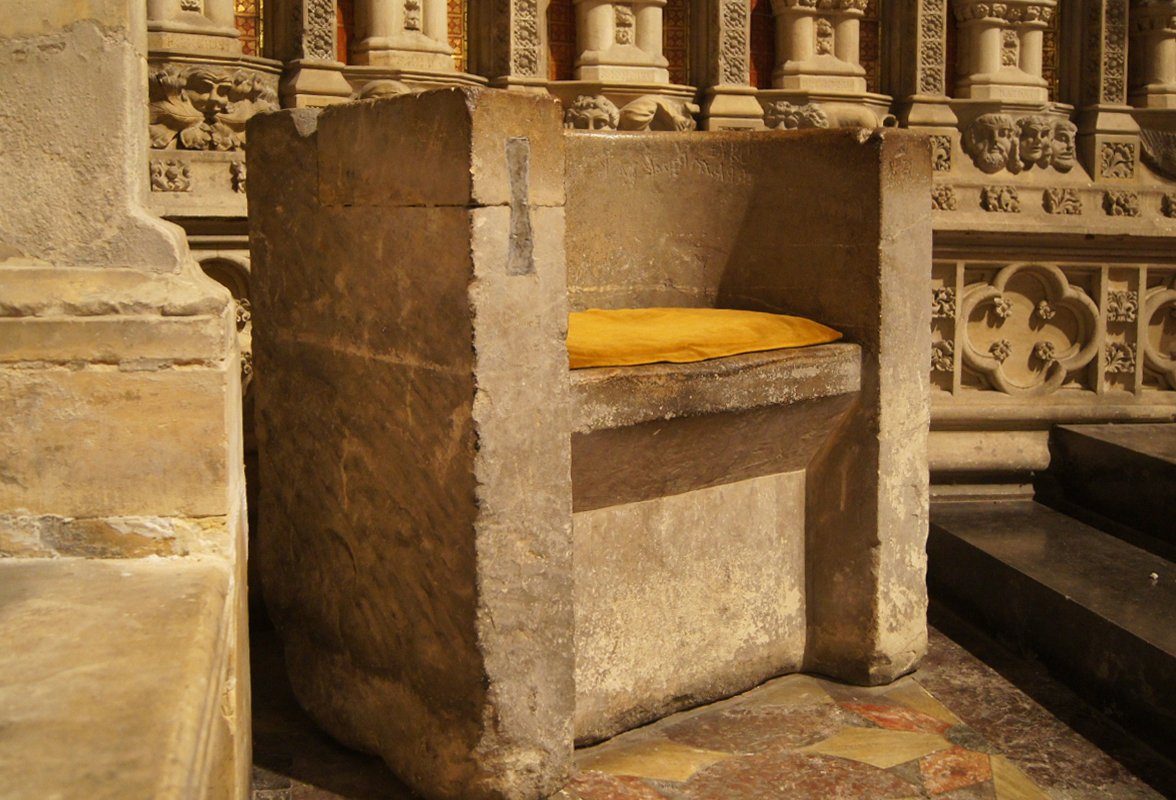
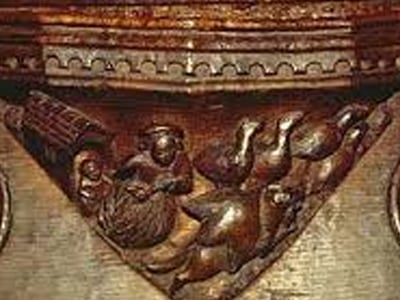
One of the 68 misericord carvings in the Quire stalls (1520).
Is there a plan of the building?
Use the plan below to find ten things worth seeking out as you walk round.
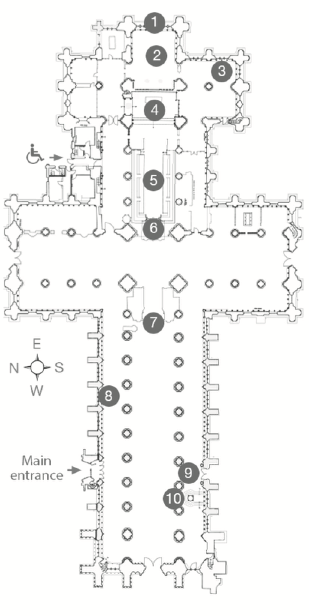
- The Great East Window, containing the Minster’s medieval glass.
- The Retro-quire, where pilgrims came in their thousands to pray at the shrine of St John of Beverley; the window and copper figures are by Helen Whittaker (2004).
- St Katherine’s Chapel, a quiet space for prayer.Psalm 46:10The Minster keeps quiet corners because stillness is where Scripture says we come to know God.“Be still, and know that I am God.”Psalm 46:10Read the passage →
- The High Altar and Sanctuary — with the eighth-century Sanctuary Chair, and the fourteenth-century Percy Canopy on the north side.
- The Quire, with its 68 early sixteenth-century stalls, each with a misericord carved beneath the seat.
- The Snetzler Organ (1769); the screen designed by Sir Gilbert Scott (1885) and carved locally by James Elwell.
- The tomb of St John of Beverley, who died in 721 and was made a saint in 1037.
- Medieval musician carvings, found throughout the building — the largest such collection in the world.
- The lead statues of St John of Beverley and King Athelstan, either side of the south door (1781).
- The Norman Font (around 1170), in Frosterley marble, still used for baptisms.
The Minster website also has illustrated “top ten” guides to the organ, the misericords and the retrochoir.
Can I take a tour?
Yes — and they are excellent. Ground-floor tours of the Minster run several times most weeks, led by guides who know the building deeply. Roof tours climb up among the towers for a view of the medieval roof structure (and the town) that very few churches anywhere can offer. Times vary week by week — check the Minster website or ask a welcomer. School and group visits can also be arranged through the Parish Office.

What about the grounds?
The churchyard is open during daylight hours when the Minster is open. It is now closed for burials and is maintained by the East Riding Council; it has snowdrops, aconites, daffodils and buddleia in season. The Sanctuary Project, funded by the National Lottery Heritage Fund, has created a wildflower area with planters, herbs and seating, accessible from the churchyard or from inside the Minster.
The Secret Garden is part of the Vicarage but is available for church use. It has a wildlife pond, a hedgehog house, log piles for mini-beasts, bird feeders, fruit trees, vegetable patches and a compost heap. Frogs, hedgehogs, numerous birds and the occasional fox call it home; flowers from the Secret Garden are sometimes used in the church. The Quiet Garden, next to the Parish Centre, is part of the international Quiet Garden Movement and is set aside for private prayer; house groups occasionally meet there in summer.
And the Parish Centre, Parish Hall and Peter Harrison Room?
The Parish Centre at 38 Highgate is the office of the Minster. The Parish Office is open Tuesday to Friday from 10.00 to 15.00 — Lauren Simpson is the Administration Manager, supported by a team of volunteer receptionists; please direct enquiries through the volunteer reception, or by email to minster@beverleyminster.org.uk. The Parish Hall sits behind the Minster and is the home of Breakfast at God’s, Minster Tots, Junior Choir, Alpha, Table Tennis and a great deal of other community life. The Peter Harrison Room is a smaller meeting room, often used for Be Still and other reflective groups. The Minster has an induction loop for hearing aids; the “T” setting works in the central Nave, from the pulpit to the Highgate entrance, and within the Quire.
Where can I read further about the building?
A small library has been written about the Minster building over the years; the most rewarding general introduction is Dr Jonathan Foyle’s Beverley Minster: History, Architecture and Meaning (2021); for a deep-dive into the architectural history, John Phillips’s “Of a Fair Uniforme Making”: The Building History of Beverley Minster 1188–1736 is unmatched. Stained Glass in Beverley Minster (2020) is the standard treatment of the windows. All three are available from the Minster Shop, where Jane Myers, the Shop Manager, is unfailingly helpful.
For those new to church buildings more generally, How to Read a Church by Richard Taylor is a wonderfully clear handbook to the symbols, layouts, art and architecture of English churches; it will turn a half-noticed detail into something readable. Also worth knowing: the Minster is part of the diocesan Parish Pass scheme, which gives members of the Minster congregation free entry to York Minster — please ask Lauren at the Parish Centre.
Saint John of Beverley and a brief history
Who Saint John of Beverley was, thirteen centuries of Christian community on this site, the present building’s story, and the Destinations Project.
There has been a Christian community on this site for over thirteen hundred years.
Who was Saint John?
John of Beverley was born in the seventh century, in a part of Northumbria that was, at the time, the heart of English Christianity. He was a member of the Whitby community under Abbess Hilda, became Bishop of Hexham in 687 and Bishop of York in 705, and ordained the Venerable Bede. In 714 he retired from his bishopric to a monastery he had founded “in the wood of the men of Deira” — what is now the site of Beverley Minster. He died in 721 and was buried in the Chapel of St Peter on the same site.
Bede, who knew him, recorded several miracles of healing — the most famous of which is the patient teaching of speech to a young man who had been mute from birth. The story has stayed with the Minster: the medal struck for the 1300th anniversary in 2021 shows the moment of the healing.
John was formally added to the Canon of Saints in 1037. By that point Beverley had become a place of pilgrimage and a centre of sanctuaryPsalm 46:1Beverley’s ancient right of sanctuary — safety for the fugitive on holy ground — reflects a truth the psalms sing of God himself as the ultimate refuge.“God is our refuge and strength, a very present help in trouble.”Psalm 46:1Read the passage → — the right of fugitives to claim safety on monastic ground, granted to Beverley by King Athelstan in 934 in thanksgiving for his victory at Brunanburgh. The pilgrim economy made Beverley one of the twelve largest towns in England by 1377.
What about the building itself?
The present Minster is the third or fourth church on the site. The first was the Anglo-Saxon monastery; a substantial Norman church followed; that was severely damaged by fire in 1188; the present Gothic building was begun in 1190 and broadly completed by 1420. It contains all three Gothic styles — Early English at the east end, Decorated through the Nave, Perpendicular at the west — combined with a continuity of detail that has made the building widely admired as one of the great Gothic churches of Europe.
After the Reformation, the Minster nearly fell down. The Collegiate Church was suppressed in 1548 and only survived because it was also a parish church; by 1552 a report described it as “in great decay, and in a short space is very likely to fall into utter ruin”. Queen Elizabeth I re-established it as a parish church in 1558 and endowed it with some of the confiscated funds, which became the basis of the “Old Fund” — the Beverley Minster Old Fund of today. Restoration in the eighteenth century, supervised by Nicholas Hawksmoor and the Yorkshire architect William Thornton, saved the north transept (which had begun to lean four feet into the street); restoration in the nineteenth century under Sir Gilbert Scott cleaned the interior and added the present organ screen; the twentieth and twenty-first centuries have continued the pattern of prudent and patient care.
What is the Destinations Project?
The Minster’s most ambitious undertaking for many years — over six million pounds over several years, with about four million sought from the National Lottery Heritage Fund. It will re-lead the Quire and Retro-quire roofs, conserve the medieval glass of the Great East Window, replace the failing lighting system, and develop the Minster’s role as a regional visitor attraction and pilgrimage church. Supported by the Friends of Beverley Minster, the Beverley Minster Old Fund and Two Churches One Town. The project runs in two phases, development and then delivery, each with its own bid to the Heritage Fund; the Minster website carries the latest news.
Caring for creation
Why the Minster cares about creation, the A Rocha Eco Church framework it works through, and how to join the Eco Church group.
Why does the Minster care about creation?
We believe that God made the world and that we are caretakers of his creation on behalf of the generations to come.Genesis 2:15Caring for the earth is one of the first tasks God gives humanity in Scripture — to tend and keep the world, not to use it up.“The Lord God took the man and put him in the garden of Eden to till it and keep it.”Genesis 2:15Read the passage → This is not an optional add-on to Christian faith; it is part of who we are as the Church.
What is the Minster doing about it?
Beverley Minster received the A Rocha Bronze Eco Church award in 2022 and is currently working towards Silver. The framework covers five areas of church life. In Worship and Teaching, we work to incorporate care for creation into preaching, prayer, and the church year. In the management of our Land — the churchyard, the Sanctuary Project wildflower area, the Quiet Garden, the Secret Garden — we manage what we have for biodiversity and access. In Lifestyle, we encourage one another to take small steps that add up: less car use, less heating, less plastic, more time outdoors. In the Management of Buildings, we are formulating a delivery plan for the Church of England’s commitment to be net zero carbon by 2030 — no small task in a Gothic building of this size and energy profile. In Community and Global Engagement, we work through Beverley Churches Together and with the East Riding Council to encourage joint action.
What does the Eco Church group do?
It meets several times a year. Its activities include lectures and events with environmental speakers, and the steady, less visible work of pushing on the Minster’s own carbon footprint. New members are very welcome.
To get involved in the Eco Church group, please ask at the Parish Centre, who will pass your name to the group’s coordinator.
What can I do at home?
The Minster publishes a short set of eco tips each month — small, practical things anyone can do, from everyday changes around the house to taking part in citizen science: recording what you find with the iNaturalist app, spending ten minutes counting pollinators, or joining a wildlife survey. They appear on the Minster website, and they are deliberately modest: the point is the habit, not the heroics.
The Minster’s Eco Creed
There is much further to go, and we are honest about that. The Minster’s own Eco Creed says it best:
We believe that God made the world and “it was good”. We share in his creativity as caretakers of his beautiful creation on behalf of the generations to come. We acknowledge, though, that through negligence and greed we have damaged and destroyed much of the planet. We believe that climate change is happening now, and that it impacts in particular the poorest and most vulnerable, who contribute least to global emissions. We believe that we need to repent, to change the way we live, and rediscover our calling to care for the whole of creation.
Generous giving
What the Minster costs to run, how to give regularly or one-off, legacies, and what the parish share (Free Will Offer) is and why it matters.
The Minster receives no support from the Church Commissioners or from central government, beyond a very limited amount of VAT relief. Everything we do is paid for by the people who love it, in their giving2 Corinthians 9:7The Minster is funded by freewill giving, not dues or fees, because Christian generosity is meant to be glad and freely chosen rather than compelled.“Each of you must give as you have made up your mind, not reluctantly or under compulsion, for God loves a cheerful giver.”2 Corinthians 9:7Read the passage → of time and of money. This page is about the money side. The matching page on time — Our community of volunteers — is at least as important.
What does the Minster cost to run?
In the region of half a million pounds a year. The largest part is what the Church of England calls the cost of ministry — the stipend, housing, pension and national insurance of our clergy, plus the salaried staff team that keeps the building open and the community supported. The rest is the constant work of looking after a building this old: heating, lighting, repairing, insuring, cleaning, and a long list of incidental costs that come with a public space open every day of the year except Boxing Day. The exact figures move from year to year — see the actual figures below for where the current position is published.
The Minster’s finances are gradually improving, though they remain finely balanced; historical reserves and occasional one-off gifts have bridged the gap in the past, but neither can be relied on for the future. Regular giving from the congregation is one of our largest sources of income. We are enormously grateful for it.
To make the figures concrete: if every regular giver were able to move up one band — if those giving £15 a month could move to £30, those at £30 to £60, and those at £60 to £100 — the financial picture for the Minster would be transformed. To move from £15 to £30 a month is an extra £3.50 a week: roughly the price of a jar of instant coffee, or a coffee in town.Mark 12:43–44In the gospel it is not the size of the gift that counts but the love behind it — Jesus praised a widow’s two small coins above the large gifts of the rich.“Truly I tell you, this poor widow has put in more than all those who are contributing to the treasury; for they contributed out of their abundance, but she out of her poverty has put in everything she had.”Mark 12:43–44Read the passage → Transforming our finances and structures is one of the four aims of the Minster’s vision strategy, Minster 28.
How do I give regularly by direct debit?
The Church of England Parish Giving Scheme is the simplest way. Used by 93,000 people across the Church of England. It allows you to commit by direct debit; to have your gift adjusted automatically each year for inflation if you wish; and to claim back Gift Aid for the Minster on your behalf. Find it via the Minster website’s Donating page, or ask at the Parish Centre for a paper form.
Can I give online or by cash?
Yes to both. The Minster website’s Donating page takes you to a one-off donation page; you can give any amount and Gift Aid it if you pay UK tax. If you would prefer cash, the yellow envelopes used in services are the way to give, and they too allow Gift Aid (£2.50 reclaimed by the Minster for every £10 given) — so do please fill them in. There are contactless donation points around the building for visitors who would like to give a one-off gift.
What about a legacy?
Gifts made through wills make a real difference to the Minster’s long-term financial health; there is more on the Minster website’s Leaving a legacy page. The standard wording is: “I bequeath the sum of £______, or ____% of my estate, free of duty, to Beverley Minster Parochial Church Council, Parish Centre, 38 Highgate, Beverley HU17 0DN, and I declare that the receipt of its Treasurer shall be a sufficient discharge for the legacy.”
What is the parish share, or Free Will Offer?
Each year, the Minster sends a substantial part of what is given to us to the Diocese of York as the parish share — also called the Free Will Offer. This is the contribution the parish makes to the diocese to fund the wider work of the Church of England in this region.
The principle is mutual support across the diocese. The cost of providing a stipendiary, housed, pensioned full-time priest now runs to over fifty thousand pounds a year, and the cost of running each “ministry unit” (a parish or group of parishes served by one incumbent) is well above that once shared diocesan support is included. Some parishes can comfortably meet the full cost of their own ministry; many cannot. The Free Will Offer takes the resources of all parishes and pools them so that ministry can continue in those parts of the diocese less able to pay their own way.
The Diocese of York sets a guideline figure each year for what each parish might give. The decision on what the Minster’s actual Free Will Offer will be is made by the PCC. As a community we believe in the principle of mutual support, and we aim to meet at least the direct cost of the ministry we receive, with a contribution to the shared work beyond that. The Free Will Offer has risen year on year as the Minster works toward meeting the full cost of the ministry it receives.
Generous giving is not, in the end, about what we owe the building. It is about a posture — that all good things come from God, and our giving is a small return of his generosity. As Saint Paul put it: “Each of you must give as you have made up your mind, not reluctantly or under compulsion, for God loves a cheerful giver.” (2 Corinthians 9:7)
Where can I see the actual figures?
The Minster’s finances are reviewed throughout the year by the PCC and the Treasurer, and the position is quite fluid — so this page deliberately keeps to the shape of things rather than the latest numbers, which would soon be out of date here. For the figures themselves, the fullest account is the Annual Report and Accounts, presented at the APCM each May and available from the Parish Office. The most recent filed accounts are also on the Charity Commission register (charity no. 1132704). For what is on and how to give today, the Minster website is always the live source. The Diocese of York also publishes helpful resources on generous giving. To talk through your own giving in confidence, please ask the Parish Centre to put you in touch with the Treasurer or with the Vicar.
How the Minster works
Who does what at the parish, what the PCC and its committees do, the widening Church-of-England structure, and the Minster’s own charities.
The Minster is a community of people; it is also a parish of the Church of England, a registered charity, a building of cathedral scale to maintain, and a partnership of bodies that have grown up over the centuries to look after different parts of the work.
Who does what at the parish?
The day-to-day life of the Minster is led by the clergy team and the staff team, in partnership with the Parochial Church Council (PCC) and supported by an extraordinary number of volunteers (described in Our community of volunteers).
The clergy team is led by the Vicar — the Revd Canon Jonathan Baker — alongside a Mission Priest, a Curate, and retired clergy who assist under the Bishop’s Permission to Officiate (PTO).
Lay ministers share in the ministry too: Licensed Lay Ministers (Readers), licensed by the Bishop to preach and lead non-sacramental services, and Authorised Lay Ministers (ALMs), commissioned to share in pastoral and teaching ministry.
The staff team is small for a building of this scale and this much daily life. A Director of Operations and an Administration Manager keep the everyday running; a Director of Music leads the music; a Youth and Children’s Minister leads work with families; a Parish Accountant looks after the books; a Shop Manager runs the Minster Shop; a Parish Safeguarding Officer oversees safeguarding; and the Virgers have the day-to-day care of the building, its services and its visitors.
Churchwardens, elected annually at the APCM, are the senior lay officers, serving the Minster and the daughter churches.
For who currently holds each of these roles — with photographs — see the Minster website, or the digital display screens at the Minster, which also carry the latest news, what’s on this week, and updates from across the Minster’s life.
What does the PCC do, and what about its committees?
The Parochial Church Council is the parish’s governing body and the board of trustees that oversees the church’s charitable works and finances. It has around twenty-five members, of whom most are elected lay members serving staggered three-year terms, with the clergy and the churchwardens of the Minster and its associated churches making up the rest, together with any co-opted members. Its key duties, set down in law, are to co-operate with the Vicar in promoting the mission of the Church in the parish, and to be responsible for the parish’s finances and the care and maintenance of the church fabric.
The PCC meets six times a year and does much of its detailed work through committees that report to it.
- The Standing Committee handles urgent business between PCC meetings.
- The Finance Committee manages the parish finances, oversees the budget, and prepares accounts for the PCC and the APCM.
- The Capital Works Board coordinates major works on the building — bringing together the Minster, the Friends, the Old Fund and Two Churches One Town with the relevant funders — so that capital projects proceed in a co-ordinated way.
- The Enterprise Committee helps raise funds by hiring the Minster out for concerts and events, and by managing the building’s wider commercial activity.
The APCM (Annual Parochial Church Meeting) is held each May, when the wardens are elected, the previous year’s accounts are presented, and members of the parish raise matters with the PCC. Approved PCC minutes are publicly displayed at the Minster and published on the Minster website, so anyone can see what was decided and why.
What is the electoral roll, and should I join it?
The electoral roll is the parish’s formal membership list — and joining it is the simplest formal way of saying “I belong here”. Being on the roll entitles you to vote at the APCM and to stand for election to the PCC; numbers on the roll also help determine how the parish is represented in the wider Church. You qualify if you are baptised, aged sixteen or over, and either live in the parish or have worshipped here regularly for six months. Joining is a short form — ask at the Parish Centre, or look out for the invitation when the roll is revised each spring. It costs nothing, and commits you to nothing beyond what you already give.
The wider Church: the Minster’s place in it
Beverley Minster sits inside a structure that widens, step by step, as you move outwards from the parish on your doorstep to the diocese and the whole Church of England. The ladder below shows the layers in order, each one containing the one before it.
The parish — the smallest unit
The parish of Beverley Minster — the parish of Saint John and Saint Martin — covers Beverley itself and includes our three associated churches at Molescroft (St Leonard’s), Tickton (St Paul’s) and Woodmansey (St Peter’s). The PCC is the parish’s governing body.
The benefice
A group of parishes that share clergy. Beverley Minster’s benefice includes our parish plus the linked parish of All Saints’, Routh, which has been linked to the Minster since the 1960s and shares our Vicar without being part of our parish. The benefice is the working unit of clergy ministry.
The deanery
A small group of parishes and benefices in a local area, led by an Area Dean and a Lay Dean, with a Deanery Synod. The deanery is the layer at which parishes share resources, plan together and look out for one another. Beverley sits within the Beverley Deanery in the East Riding of Yorkshire.
The archdeaconry
A larger group of deaneries, led by an Archdeacon. The Diocese of York has three archdeaconries: York, Cleveland and the East Riding. Beverley sits within the Archdeaconry of the East Riding.
The Diocese
The regional unit of the Church of England, led by the Archbishop of York and supported by the Bishops of Hull, Selby and Whitby and a body of diocesan staff. The Diocese of York covers the City of York, the eastern part of North Yorkshire, and most of the East Riding. There are 442 parishes and 579 churches across the diocese. The diocesan vision strategy — Living Christ’s Story — sets the framework within which the Minster’s own vision strategy, Minster 28, has been developed; both stress missional discipleship, becoming more like Christ, reaching those we currently don’t, and transforming structures and finances. Minster 28 focuses on discipleship, youth and children, the place of music in mission and ministry, and the next phase of conservation work on the building. Wydale Hall, near Brompton-by-Sawdon on the edge of the North York Moors, is the diocesan retreat house.
The Minster’s own charities and partnerships
Beverley Minster also has, around the parish, several charities and partnerships of its own. They are not part of the diocesan structure above; they exist specifically to support this place.
The Friends of Beverley Minster is a registered charity founded in 1936 with around four hundred and thirty members from across the country and beyond. The Friends have funded restoration, music, scholarship and improvements to the building over nearly ninety years; recent contributions include the Steinway grand piano, the Choral Foundation’s music lessons for choristers, organ work, and a steady stream of conservation and interpretation projects.
The Beverley Minster Old Fund (BMOF) is the historic charity whose endowment was established in 1579, when Queen Elizabeth I re-endowed the Minster with some of the funds confiscated at the suppression of the Collegiate Church. The Old Fund is an independent charity with its own constitution, responsible for maintaining the fabric of the Minster under authority delegated to it each year by the PCC — which retains ultimate legal responsibility for the building — and it works with the Friends on capital projects.
Two Churches One Town is the partnership between Beverley Minster and St Mary’s, the other historic parish church in the centre of the town. It co-ordinates major fundraising between the two churches so that they are not in competition with one another, and is a partner in the current Destinations Project.
The Destinations Project is the Minster’s most ambitious undertaking for many years. See Saint John of Beverley and a brief history for the fuller account.
elects ↓
delegates detailed work to ↓
is supported by ↓
Safeguarding
What safeguarding really is, the Minster’s commitment to being a church for everyone, what we are committed to, and who to contact with a concern.
What is safeguarding really about?
It is sometimes seen as a piece of necessary paperwork — annual training, DBS forms, policies that exist mostly to be filed away. The paperwork matters, and we do it carefully. But it is not what safeguarding actually is. Safeguarding is about looking after everyone in the community: the daily, attentive practice of recognising that we are all carrying our own histories and our own biases into the room, and that the work of being a safe community for each other is everyone’s job, not just the safeguarding officer’s. It is part of the gospel’s long-standing commitment to the protection of the vulnerableMatthew 18:10Protecting and honouring the vulnerable — children above all — runs right through the gospel; Jesus warned his followers never to look down on the little ones.“Take care that you do not despise one of these little ones; for I tell you, in heaven their angels continually see the face of my Father in heaven.”Matthew 18:10Read the passage →, and part of the Christian community’s ongoing repentance for the times when its institutions have failed to do that.
A church for everyone — what do we mean by that?
Safeguarding sits inside a wider commitment, which is worth saying out loud. We believe Beverley Minster is a church for everyone. The Diocese of York’s safeguarding training puts it like this: safeguarding is a theological imperative, rooted in the nature and love of God, and is worked out in practical commitments that give equal worth to every person. Our purpose as God’s Church is to create environments in which everyone is safe and can flourish — and that means everyone.
In practice, that means this is a church for the curious and the long-committed; for those of every age, from the babies in the crèche to those who have worshipped here for decades; for women and men and those whose experience of gender does not fit neatly into either box; for those who are gay, straight, single, partnered, married, divorced and widowed; for parents and carers, including those bringing children with additional needs; for people of every ethnicity, background and first language; for people with physical disabilities, sensory impairments, learning differences and neurodivergent ways of meeting the world; for those carrying mental ill-health and those holding others up through it; and for the great many of us for whom several of those descriptions overlap. There is, as the diocesan training puts it, more to each of us than meets the eye.
We are aware, too, that we sit inside a tradition and an institution that have not always held this commitment well. The wider Church has a painful record of failures around the dignity, inclusion and safety of those who have trusted it, and the work of repentance is ongoing. If something in your experience here suggests we are falling short of the welcome we describe, please tell us. The contacts below are open to that conversation as well as to safeguarding concerns in the narrower sense.
What are we committed to?
- Promoting a safe environment and a safe culture in the worshipping community.
- Safely recruiting and supporting all those with any responsibility for children or vulnerable adults.
- Responding promptly to every safeguarding concern or allegation, however small.
- Caring pastorally for victims and survivors of abuse, and for any others affected.
- Caring pastorally, and appropriately, for those who are the subject of safeguarding concerns or allegations.
- Responding appropriately to those who may pose a present risk.
In practice, anyone who works with children, young people or vulnerable adults at the Minster has been safely recruited with relevant checks and training. We have a clear safeguarding policy, reviewed annually, that follows the framework of the Diocese of York and the Church of England national guidelines.
What if I feel unsafe in our community?
There is a wider question worth naming directly: what to do if you feel unsafe in our community for reasons that do not amount to a safeguarding concern in the strict sense. Bullying, harassment, or behaviour that makes you feel unwelcome, demeaned or unsafe — these matter, and we want to know about them. The Diocese of York has a bullying and harassment policy that applies across diocesan life and is available on the diocesan website. If you would prefer to raise a concern outside the Minster’s own structures, the diocesan team will hear you confidentially.
What is White Ribbon?
The Minster is a partner of White Ribbon, a global movement dedicated to ending violence against women and girls by engaging men and boys as allies. Founded in 1991 in Canada, White Ribbon uses the white ribbon as a symbol of a public pledge: never to commit, condone, or remain silent about gender-based violence. Many in our congregations have made the White Ribbon promise.
Who do I contact with a concern?
If you have a concern about the safety or welfare of a child, young person or adult connected with the Minster, please speak to one of the people below. You can also use the safeguarding concern form on the Minster website, which is the preferred way to raise a concern in writing; the website also explains how to report a concern.
Reporting a safeguarding concern
- Parish Safeguarding Officer Meg Choules Call 01482 868540 (ext 213) safeguarding@beverleyminster.org.uk
- The Vicar Revd Canon Jonathan Baker Call 01482 868540 (ext 208) vicar@beverleyminster.org.uk
- Diocese of York Safeguarding Team Rob Marshall Call 07551 124951 safeguarding@yorkdiocese.org.uk
In immediate danger, call 999.
Glossary
A short reference for the words that appear in this Companion and in Anglican worship more generally. None of it is a test.
Use it however helps: skim it now, or come back to it when a word puzzles you. Across the Companion, dotted-underlined words link back here — hover (or tap) for a quick definition.
A
- Advent — the four Sundays before Christmas; the start of the church year, and a season of expectation.
- ALM — Authorised Lay Minister; a lay person authorised by the Bishop for a particular local ministry, such as pastoral or teaching work. The authorisation is for a specific role in a specific place — which is the main difference from a Licensed Lay Minister (see LLM), whose licence is a national, more formal and portable form of lay ministry.
- Alpha — a relaxed series of evening conversations exploring the basics of Christian faith — a meal, a film and small-group discussion — run at the Minster and in churches worldwide.
- Anthem — a free-standing piece of music sung by the choir during a service.
- APCM — Annual Parochial Church Meeting; the parish’s annual general meeting in May.
- Archdeaconry — a grouping of deaneries overseen by an Archdeacon. Beverley sits within the Archdeaconry of the East Riding.
B
- Baptism — the sacrament of beginning in the Christian church, marked with water; sometimes called a christening.
- BCP — the Book of Common Prayer; the historic Anglican prayer book, finalised in 1662.
- Benefice — a group of parishes that share clergy. The Minster’s benefice includes the linked parish of All Saints’, Routh.
C
- Canticle — a sung scriptural text used as a regular part of the daily office, such as the Magnificat or Nunc Dimittis.
- Chorister — a child singer in the choir.
- Churchwarden — a lay officer, elected annually at the APCM, who shares responsibility for the life and fabric of the parish.
- Collect — a short prayer that “collects” the prayers of the people for a particular day or theme.
- Compline — the quiet last service of the day, also called Night Prayer.
- Confirmation — the moment a baptised Christian affirms the promises of baptism for themselves, with prayer and the laying-on of hands by a Bishop.
- Creed — a summary statement of Christian belief said together in worship; most often the Apostles’ Creed or the Nicene Creed.
- CW — Common Worship; the Church of England’s modern liturgical collection, authorised in 2000.
- Curate — a priest in their first formal post after ordination, working under the supervision of an experienced incumbent.
D
- Daily Office — the structured daily pattern of Morning, Midday, Evening and Night Prayer that the Anglican tradition inherited from monasticism.
- Deanery — a local group of parishes and benefices, led by an Area Dean and a Lay Dean. Beverley sits within the Beverley Deanery.
- Diocese — the regional unit of the Church of England. Ours is the Diocese of York, led by the Archbishop of York.
E
- Electoral roll — the parish’s formal membership list. Joining entitles you to vote at the APCM and stand for the PCC.
- Eucharist / Holy Communion — the central sacrament of Christian worship, in which bread and wine are shared.
- Evensong — sung evening prayer; in its choral form, largely unchanged since the first English prayer book of 1549.
F
- Free Will Offer — another name for the parish share; the contribution each parish makes to the diocese.
H
- Holy Spirit — the third person of the Holy Trinity: God present and at work in the world and in the lives of believers. Older English (including the Book of Common Prayer) often calls the same thing the Holy Ghost — the two are interchangeable.
- House group — a small group meeting in a home, weekly or fortnightly, for study, conversation and prayer.
I
- Intercessions — the prayers for the church, the world and those in need, usually led by a lay person after the sermon.
- Introit — a short opening sung piece that sets the atmosphere for worship.
L
- Lectionary — the calendar of biblical readings used in worship.
- Lent — the forty days of preparation before Easter, beginning on Ash Wednesday; traditionally a season of self-examination and fasting.
- Liturgy — the formal shape of a service; from the Greek leitourgia, “the work of the people”.
- LLM — Licensed Lay Minister, also known as a Reader; a lay person licensed by the Bishop to preach and lead non-sacramental services.
M
- Magnificat — the Song of Mary, sung at Evensong.
- Mattins — an older name for Morning Prayer.
- Misericord — a hinged Quire-stall seat with a small ledge underneath that supports the singer through long services.
N
- Nunc Dimittis — the Song of Simeon, sung at Evensong.
O
- Ordinary time — the parts of the church year not covered by Advent, Christmas, Lent or Easter; from the Latin for “counted”.
P
- PCC — Parochial Church Council; the parish’s governing body.
- Peal — an extended, continuous performance of change-ringing on a tower’s bells; a full peal runs to several thousand changes over about three hours.
- Psalter — the Book of Psalms arranged for worship. At the Minster’s Evensong the psalms are sung from Miles Coverdale’s sixteenth-century translation.
- PTO — Permission to Officiate; granted by the Bishop to retired clergy who continue to assist.
Q
- Quire — the eastern part of a church where the choir sits and the daily office is said.
R
- Reader — a lay person licensed by the Bishop to preach and lead non-sacramental services. See LLM.
- Retro-quire — the part of a church behind the high altar.
S
- Sacrament — an outward and visible sign of an inward and spiritual grace; in Anglican practice, especially Baptism and the Eucharist.
- Sacristan — someone who prepares the vessels, linens and practical needs of a service.
- Sanctuary — the area around the high altar; also, historically, the right of fugitives to claim safety on monastic ground.
- Setting — a named composer’s music for the fixed words of the liturgy — the Magnificat at Evensong, or the Sanctus at the Eucharist.
- Stipend — the salary paid to a parish priest by the diocese.
- Synod — a representative church council. Parishes elect members to the Deanery and Diocesan Synods; nationally, the General Synod.
T
- Taizé — a contemplative style of worship from the ecumenical community at Taizé in France: short sung chants, repeated, with silence and candlelight.
- Transept — one of the two arms of a cross-shaped church.
V
- Vestments — the robes worn by those leading worship; their colours follow the seasons of the church year.
- Via media — Latin for “the middle way”; Anglicanism’s habit of holding breadth within one church.
- Vicar — the parish priest; at Beverley, the incumbent of the Minster parish.
- Virger — a senior member of the church staff responsible for the practical care of the building, services and visitors. (“Verger” is the more usual spelling elsewhere; the Minster uses “Virger”.)
- Voluntary — the organ piece played at the end of a service, as worship spills out into ordinary life.
Spotted a term we have missed? Please let us know so we can add it.
Final thoughts and acknowledgements
A closing reflection on the breadth being the point, and thanks to the many hands that shaped this Companion.
If you have read this far, you have done one of the things this Companion was written to make easier — sat with the breadth of the Minster’s life for long enough to begin to make sense of it. The breadth was, and is, the point.
The building you have read about is precious; it always needs the next round of careful conservation. But the centre of weight is in the people who gather here, week by week, to worship and serve. That is what the Minster, in the end, is.
Wherever you go from here — into a service, into a quiet conversation, into a house group, into the Eco Church group, into prayer in St Katherine’s Chapel, into nothing at all for now — you are very welcome. Please come again, and please do let us know if there is something we should add, change or correct.
With love,
The Minster Companion editorial team
Thanks
This Companion has been shaped by — and built on the existing work of — many hands. Particular thanks to the clergy team (Jonathan, Eileen, Charlie, Allan and Chris); to the staff team (Robert, Ben, Kate, Lauren, Jane, Meg, Libby, Paul and Roberto); to the lay ministers (David, Catherine, Jane and James); to Mervyn King, our webmaster, for the visual assets we have drawn on; to Chris Chipperton, Treasurer, for his eye over the giving section; and most of all to the great community of volunteers — welcomers, sides team, choristers, bell ringers, gardeners, prayer ministry team, Eco Church group, hospitality team, sacristans and many more — without whom there would be no Minster community as we know it.
A reminder. The Minster website at beverleyminster.org.uk is the primary source of up-to-date information about services, events and what is on this week. The Companion is a supplementary read alongside it.