

Worship at the Minster
The four Sunday services and the rhythm of the week, with what to expect at each — and baptisms, weddings and funerals.
On this page
- Why does the Minster have so many services on a Sunday?
- What is each of the four Sunday services like?
- 8.00 — Holy Communion (BCP)
- 9.15 — Contemporary service (CW)
- 11.00 — Choral Holy Communion (CW)
- 5.30 — Choral Evensong (BCP)
- What about our daughter and linked churches?
- Do I have to come up for Communion?
- When am I supposed to stand, sit and kneel?
- What about the rest of the week?
- Can I follow services from home?
- I was baptised but never confirmed. Does that matter?
- Can I read or lead the prayers at the 11 o’clock?
- What about baptisms, weddings and funerals?
More questions are asked about our worship than about anything else in the Minster’s life. This section takes them in turn.
Why does the Minster have so many services on a Sunday?
Four services across a Sunday — three in the morning, one at half past five — is a lot, and it is a fair question. We believe each meets a different congregation in a different way, and would rather offer all four than ask everyone to fit into one. Each has its own people, its own pace, its own theology in the air. We run all four because the breadth is the point.
| Time | Service | Where | Style |
|---|---|---|---|
| 8.00 | Holy Communion (BCP) | In the Quire | Quiet, said, in the language of 1662 |
| 9.15 | Contemporary service (CW) | At the West End | Café-church style: tables, band, modern songs |
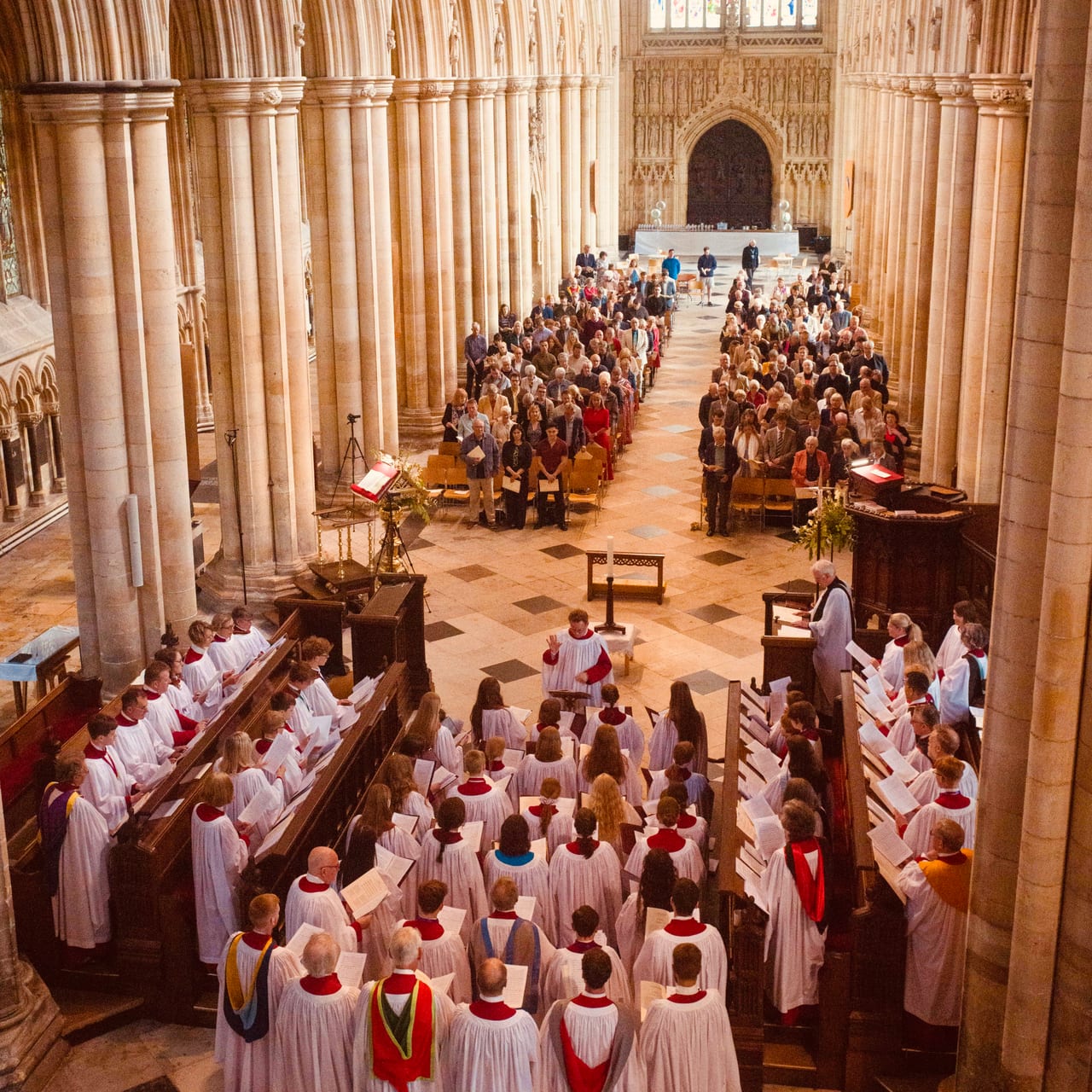
| 11.00 | Choral Holy Communion (CW) | In the Nave | Sung settings led by the Minster Choir |
| 5.30 | Choral Evensong (BCP) | In the Quire | Sung evening prayer in the Anglican tradition |
Service times in our daughter and linked churches vary; please see the weekly notice sheet for the current week.
What is each of the four Sunday services like?
Here is each in turn, in the order it falls across the day.
8.00 — Holy Communion (BCP)
You will find this the quietest service of the Minster’s week. Around thirty people gather in the Quire stalls for Holy CommunionLuke 22:19At the Last Supper Jesus broke bread and told his friends to keep doing it in memory of him. Every service of Holy Communion is the Minster keeping that command.“This is my body, which is given for you. Do this in remembrance of me.”Luke 22:19Read the passage → using the Book of Common Prayer of 1662. The service is said rather than sung, lasts around forty minutes, and is followed by Breakfast at God’s in the Parish Hall — butties, toast, coffee and juice — until 9.30. What makes the service distinctive is its restraint. The cadence of Cranmer’s English is unhurried and dignified; the form has hardly changed in three and a half centuries; many who come treasure both. If you have never heard the Prayer of Humble Access read aloud — “We do not presume to come to this thy table, O merciful Lord, trusting in our own righteousness, but in thy manifold and great mercies” — it is worth coming once to hear it.
9.15 — Contemporary service (CW)
A contemporary service held at the West End under the great west window, in the café-church style — people sit at tables, with tea, coffee and conversation built into the rhythm rather than tacked on at the end. The musical idiom is more recent: a band leads modern worship songs, words appear on a screen, the teaching is in an accessible style. There is a children’s table during the service. The service runs for about an hour. Rather than following a set liturgy word for word, it is shaped afresh each week within a broad Common Worship framework, and includes Holy Communion on the second Sunday of the month. Prayer ministry is available during and after the service.
Both the 9.15 and the 11.00 are family-friendly; the 9.15 is the more informal of the two and hospitable to those who find a fully liturgical service unfamiliar. If you have come having last been at church as a child and found that hard, the 9.15 is often the easiest first step.
11.00 — Choral Holy Communion (CW)
The 11.00 is a Common Worship Holy Communion in the Nave, with the Minster Choir leading the sung settings of the liturgy in the generous acoustic of the building. The service runs for about an hour and a quarter. Children leave during the first hymn for age-group activities at the East End and rejoin in time for the PeaceMatthew 5:23–24Jesus taught that before we bring our gift to the altar we should first be reconciled — so we make peace with one another before we come to the Table.“So when you are offering your gift at the altar, if you remember that your brother or sister has something against you, leave your gift there before the altar and go; first be reconciled to your brother or sister, and then come and offer your gift.”Matthew 5:23–24Read the passage → and Holy Communion. Prayer ministry is offered during Communion and after the service.
What you may notice is the scale and the musical inheritance. The Minster Choir is one of the largest parish church choirs in the country, with separate top lines of Boys’, Girls’, Consort and adult sopranos and a back row of altos, tenors and basses. The choral inheritance reaches back, in this place, eight hundred years.
5.30 — Choral Evensong (BCP)
Choral Evensong is one of the great inheritances of the Anglican Church and one of its quietest gifts. It is a sung evening prayer with a structure that has been largely unchanged since the first English-language Book of Common Prayer of 1549. The choir leads; the congregation listens, joins in the responses and the hymn, and finds itself, after about an hour, considerably more settled than it began.
Its purpose, in a sentence, is to give the day to God. After an opening introit and a hymn, the minister and choir sing the opening responses. The choir sings the appointed psalm. The first reading is from the Old Testament. The choir sings the Magnificat — Mary’s song of praise, given in Luke’s Gospel. The second reading is from the New Testament. The choir sings the Nunc Dimittis — Simeon’s prayer at recognising the infant Christ in the Temple. There is the Apostles’ Creed, more sung prayers, and an anthem. On Sundays a short sermon follows; then prayers, the closing hymn, and the dismissal.
What about our daughter and linked churches?
Three nearby village churches are formally “associated churches” of the Minster parish: St Leonard’s, Molescroft; St Peter’s, Woodmansey; and St Paul’s, Tickton. Each is a worshipping community in its own right, with its own congregation, character and life. Each has its own churchwardens, who — for the three associated churches — are ex-officio members of the Minster’s PCC; the Minster’s clergy and lay ministers officiate at their services, and service times for all of them are kept on the Minster website. The fourth, All Saints’, Routh, is a separate parish in its own right, but has been linked to the Minster since the 1960s and shares our Vicar. Together with the Minster, the five churches form the Beverley Minster benefice. There is more about each of them — their character, history and life — in The wider parish: our associated churches.
Do I have to come up for Communion?
No. At every service, you are equally welcome to come forward for Communion if you are normally a communicant in any Christian church, or to come forward for a blessing — simply cross your arms across your chest as you reach the priest. You are equally welcome to stay in your seat, in which case nothing at all is asked of you.
When am I supposed to stand, sit and kneel?
There is no test. Moving with the service — standing, sitting, kneeling — is one of the ways we worship with our bodies as well as our minds, and it is entirely optional. The general pattern: stand to praise (hymns, the Creed, the Gospel); sit to listen (readings, the sermon); kneel or sit to pray. The order of service tells you when. If you are not sure, look at the row in front and follow. If any of it is uncomfortable, please stay seated.
What about the rest of the week?
Midweek the Minster offers Holy Communion on Thursday mornings at 10.00 (alternating week by week between the BCP and Common Worship), Choral Evensong on Thursday evenings at 7.30, and Taizé on the fourth Monday evening of the month at 7.00 (except in August and December). Taizé is a French ecumenical contemplative tradition in which short, simple chants are sung repeatedly while the congregation rests in silence and candlelight — the closest accessible cousin to monastic prayer. Morning Prayer is said in the Quire at 8.00 each weekday. Midday Prayers are said at noon on most weekdays.
Thursday Evensong, at 7.30, is the same service in a quieter key and with no sermon: music, scripture and prayer at the close of the working day, and for many people the easiest way into Evensong.
Can I follow services from home?
Yes. The principal services are livestreamed on the Minster’s YouTube channel and Facebook page. If you are housebound, recovering, away or simply not yet ready to come in person, you are very welcome to follow from home. Recordings remain available afterwards on YouTube; the Minster website’s live-streamed services page has the links.
I was baptised but never confirmed. Does that matter?
Not in any urgent sense, but worth knowing what confirmation is. Confirmation is the moment a Christian who has been baptised — usually as an infant, increasingly often as an adult — re-affirms for themselves the promises made at baptism. The Bishop prays for the person with the laying-on of hands for the gift of the Holy Spirit. In Anglican tradition, confirmation is the gateway to receiving Holy Communion. The Minster runs preparation classes (often using the Pilgrim or similar course) ahead of confirmation services, which take place once or twice a year. If you would like to be confirmed, please speak to one of the clergy; nothing about it is rushed. The Church of England’s page on confirmation explains the step in more depth.
Can I read or lead the prayers at the 11 o’clock?
We always welcome new readers and intercessors. Reading at a service means reading aloud one of the appointed scripture passages from the lectern; leading the intercessions means writing and leading the prayers for the church, the world and those in need that come after the sermon. Both rotas are friendly; we will pair you with someone who has done it before for the first few times. To go on the rota, please email the Parish Office at minster@beverleyminster.org.uk.
What about baptisms, weddings and funerals?
To make arrangements for any of these, the Minster website’s baptisms, weddings and funerals page is the place to start. If you would like to ask something first, email the Parish Office at minster@beverleyminster.org.uk. Baptism (sometimes called a Christening) marks the beginning of a person’s life as a member of the Church. We hold baptism services for babies and young children at 2.00 on the third Sunday of the month at the Minster, with up to three families involved. Adult baptism is also possible and warmly welcomed. The Church of England’s christenings guide is a gentle introduction to what it all means.
Weddings at the Minster are subject to the usual eligibility rules — broadly, a connection to the parish — but the rules are less restrictive than they used to be, and we will be happy to talk you through your options. Your Church Wedding explains how the connection works and what to expect.
Funeral arrangements are made first with the funeral director, and our clergy take many funerals each week, in the Minster, in our daughter and linked churches, and in cemeteries and crematoria. A service for the bereaved is held at the Minster each year, around Christmas. The Church of England’s funerals pages offer help and reassurance for the bereaved.
To give a sense of scale: in a typical recent year the clergy conduct around twenty baptisms, a dozen weddings and thirty or more funerals across the parish.
Section 9 of 26 in the Companion
Discovering more
On the Minster website
Books to explore further
- Why Go to Church? The Drama of the EucharistA warm account of what is really happening when a congregation gathers to worship.
- The Book of Common PrayerThe words at the heart of Choral Evensong, in a clearly annotated edition.
- O Sing unto the Lord: A History of English Church MusicThe story of the choral tradition you hear sung at Evensong.
Book links open Waterstones; many titles are also at the Minster shop or your local bookshop.
Other websites
Offered as helpful starting points. These sites are not the Minster’s own, and may not reflect its views or tradition.