

A breadth of worship and life
The section that explains the rest: one community holding a cathedral-scale breadth of worship and life as the middle way.
This is the section that explains the rest of the Companion.
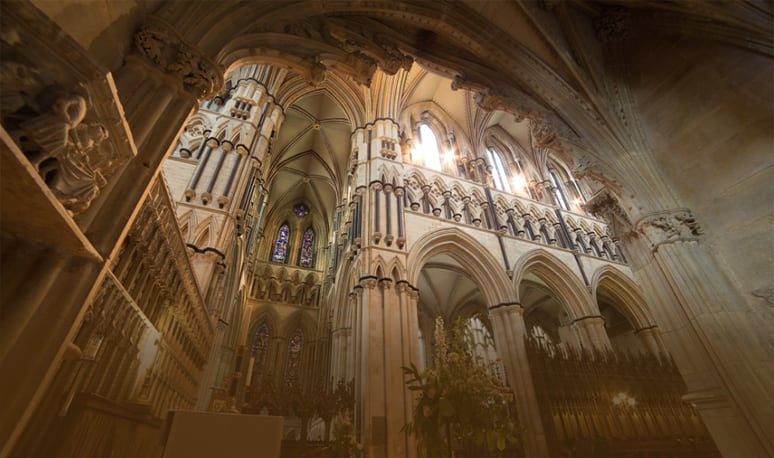
Beverley Minster is, by some measures, the largest parish church in England that is not a cathedral. We are a parish, with a parish’s ordinary commitments to those who live within our boundary; and we are a building of cathedral scale, with the music, heritage and regional draw of one. We are one Christian community, and the breadth of how we worship and live together is part of what marks us out.
Imagine a Sunday morning in slow motion. At 8.00, around thirty people gather in the Quire for Holy Communion using the Book of Common Prayer of 1662 — quiet, said, around forty minutes, treasured for its older language. At 9.15, a different group gathers at the West End for the contemporary service — a band, modern songs, tables for conversation, a children’s table, less formal. At 11.00, the Minster Choir leads Choral Holy Communion in the Nave, and the building begins to feel its size. At 5.30, a smaller congregation gathers in the Quire for Choral Evensong, sung in much its present form since 1549.
Add Taizé on the fourth Monday evening of the month, midweek Communion on Thursday morning, Choral Evensong on Thursday evening, the daily Office of Morning Prayer at 8.00, the three associated churches at Molescroft, Woodmansey and Tickton, the linked parish at Routh, and the breadth of week-day life — house groups, the Exploring Spirituality Group, Be Still, Press Pause, Food and Fellowship, Breakfast at God’s, Alpha, Minster Tots, the Junior Choir, the Youth Group, the bell ringers, the walking group, the Eco Church group, the prayer ministry team, the Wellbeing Team, the welcomers, the gardeners — and the picture is something more like a quiet ecology than a single congregation.
The Minster is, in this sense, an unusually broad expression of what the Anglican tradition has long called the middle way. We hold within one church a breadth of styles and traditions that other places tend to separate into different buildings. This is by design rather than accident. The other sections describe each corner with the same care.
The breadth also means newcomers can find their way in through many different doors. Six paths into faith takes that idea seriously, mapping six ways into Christian faith with the Minster’s resources matched to each.
Section 4 of 26 in the Companion
Discovering more
On the Minster website
Other websites
Offered as helpful starting points. These sites are not the Minster’s own, and may not reflect its views or tradition.